TL;DR
Putting power, data, and fire-alarm cables in the same tray to save a route is a false economy. The three circuit categories interfere with each other electrically, the practice fails a competent code review, and it puts life-safety circuits at risk during the one event they exist for. Segregation is a requirement, not a refinement.
| Circuit category | Why it must be kept separate |
|---|---|
| Power (LV distribution) | Generates magnetic fields that induce noise into nearby signal and data cabling |
| Data and signal (Cat 6A, controls, instrumentation) | Susceptible to induced interference; performance degrades when run alongside power |
| Life-safety (fire alarm, emergency lighting, smoke control) | Must survive a fire long enough to do its job; cannot share a route’s failure mode with general power |
This guide covers the three reasons segregation matters, how power and data interact, why life-safety circuits are a separate problem, and how to segregate properly — in the design and on site.
Three reasons segregation matters
Segregation is not a preference. There are three independent reasons it is built into competent designs, and any one of them is sufficient on its own.
1. Electromagnetic interference. A current-carrying power conductor produces a magnetic field around it. A data or signal cable run close to that conductor sits inside the field and picks up induced voltage — electrical noise the data system did not put there and cannot fully reject. The closer the run and the longer the parallel length, the worse the coupling.
2. Code compliance. Segregation of circuit categories is addressed by the wiring standards a design is reviewed against. IEC 60364-5-52, on the selection and erection of wiring systems, addresses the grouping and separation of circuits of different categories. PUIL 2011, the Indonesian electrical installation code, governs the same ground locally. A design that mixes categories in one enclosure is not a clever optimisation — it is a finding waiting for the reviewer.
3. Fire survivability. Power, data, and fire-alarm circuits do not need to survive the same conditions. General power can fail in a fire; the fire-alarm circuit must not, at least not before it has done its job. Sharing a route ties the survivable circuit to the failure mode of the one that does not need to survive.
Power into data: the interference problem
Balanced data cabling — Cat 6A and similar — and shielded signal cabling are designed to reject interference. They do it well, but not perfectly, and not infinitely. Twisting cancels much of the induced noise across a pair; a screen drains more of it to earth. Neither mechanism removes the interference. They reduce it.
The primary defence is not the cable. It is distance. Induced coupling falls off sharply as the separation between the power conductor and the signal cable increases. A data circuit run with adequate physical separation from power needs far less help from screening and twisting; a data circuit cable-tied alongside a power feeder is relying on the cable to fix a problem the layout created.
There is no single separation distance to quote here, because the correct figure depends on the project’s EMC and structured-cabling specification and the standard it is written against. The decision rule is simpler than a number: treat the required separation as a specified dimension, not an installer’s judgement. The project EMC or cabling specification states it; the layout must deliver it; the inspection must confirm it. Where parallel runs cannot be avoided, separation and screening are specified together — but separation does the heavy lifting.
Life-safety circuits: a separate problem
Fire alarm, emergency lighting, and smoke-control circuits are not “important power and data.” They are a different class of circuit with a different job, and they must be treated as such.
NFPA 72, the fire alarm code, governs how fire-alarm systems are designed, installed, and maintained. The principle that matters for cable management is survivability: a fire-alarm circuit has to keep working in the conditions it is meant to detect and signal. That is why life-safety circuits use fire-rated cabling specified to the project’s circuit-integrity requirement — and why the route those cables run on matters as much as the cable itself.
A fire-rated cable on a shared route is only as survivable as the route. If a life-safety circuit shares a tray with general power, three things follow. A fault on the power circuit can damage the life-safety circuit. Mechanical disturbance during the fire — falling debris, other cables burning through — affects both. And the segregation a reviewer expects to see simply is not there.
The decision rule: if a power conductor shares an enclosure with a fire-alarm circuit, the fire-alarm circuit is not segregated. Life-safety circuits get dedicated, separated routes. This is not gold-plating. It is the difference between a system that works on the day it is needed and one that was only ever specified to work on paper.
How to segregate in practice
Segregation is a layout problem with several accepted solutions. The right one depends on space, route width, and how strictly the categories must be isolated.
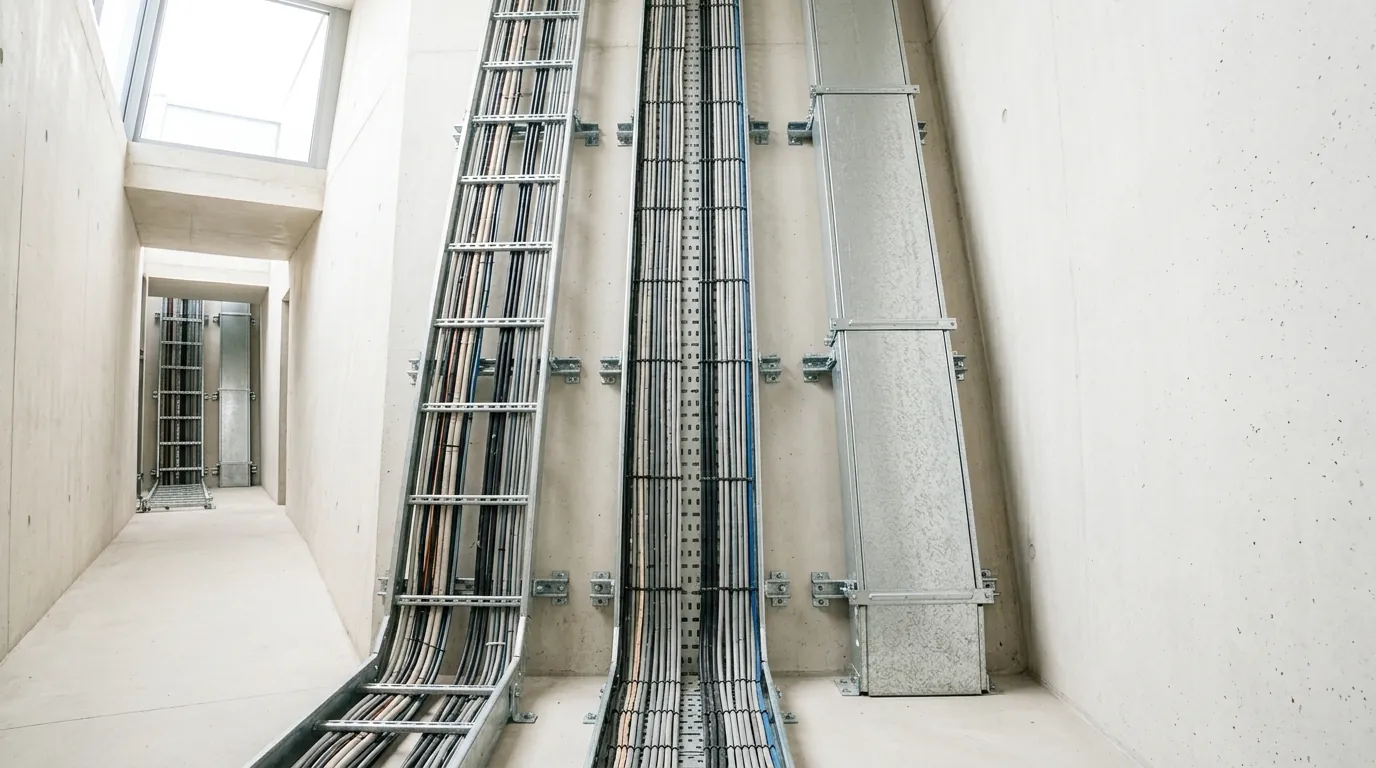
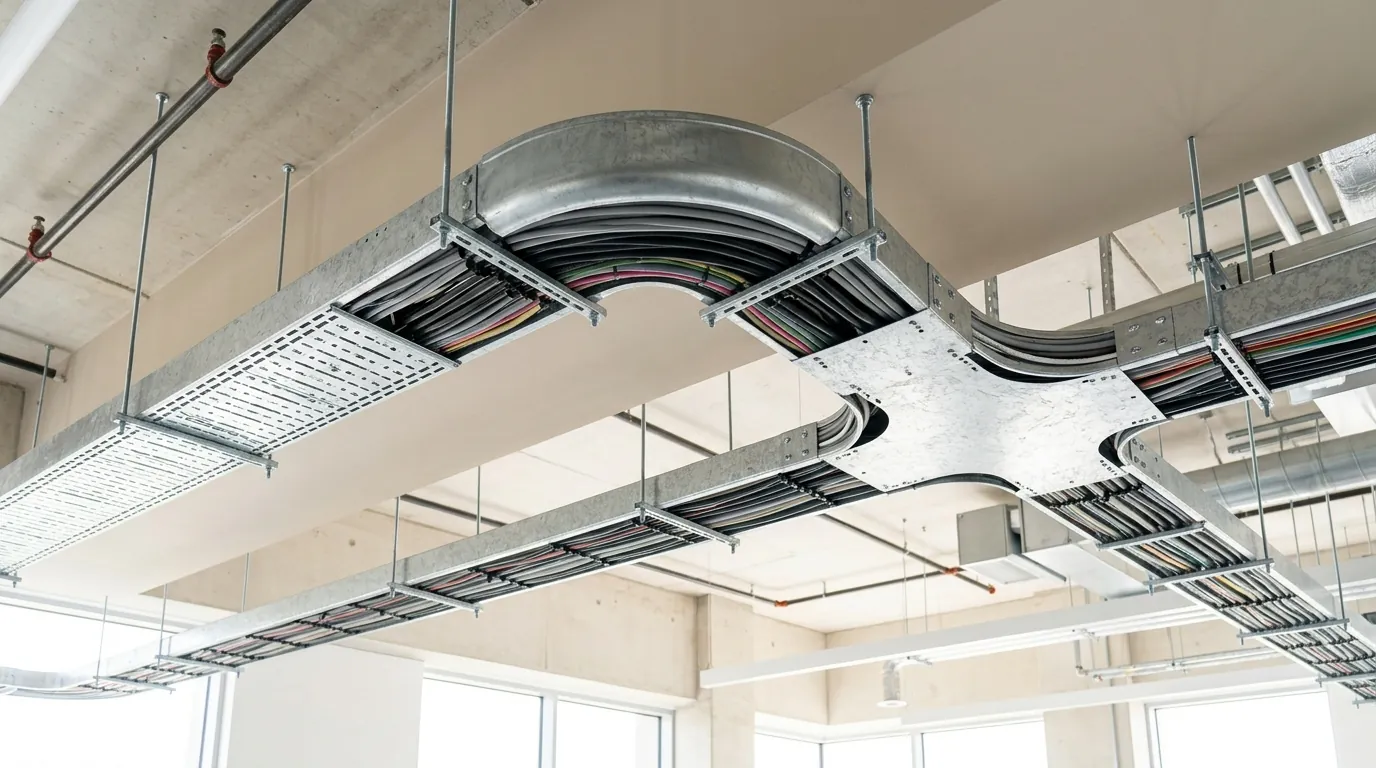
- Separate trays or ladders. The cleanest approach: each circuit category on its own dedicated cable tray or cable ladder. Unambiguous to install, unambiguous to inspect.
- Divider strips in a wide tray. Where one wide tray carries more than one category, a longitudinal divider creates physically separated compartments within the single tray — useful when route space is tight but the categories still need a barrier between them.
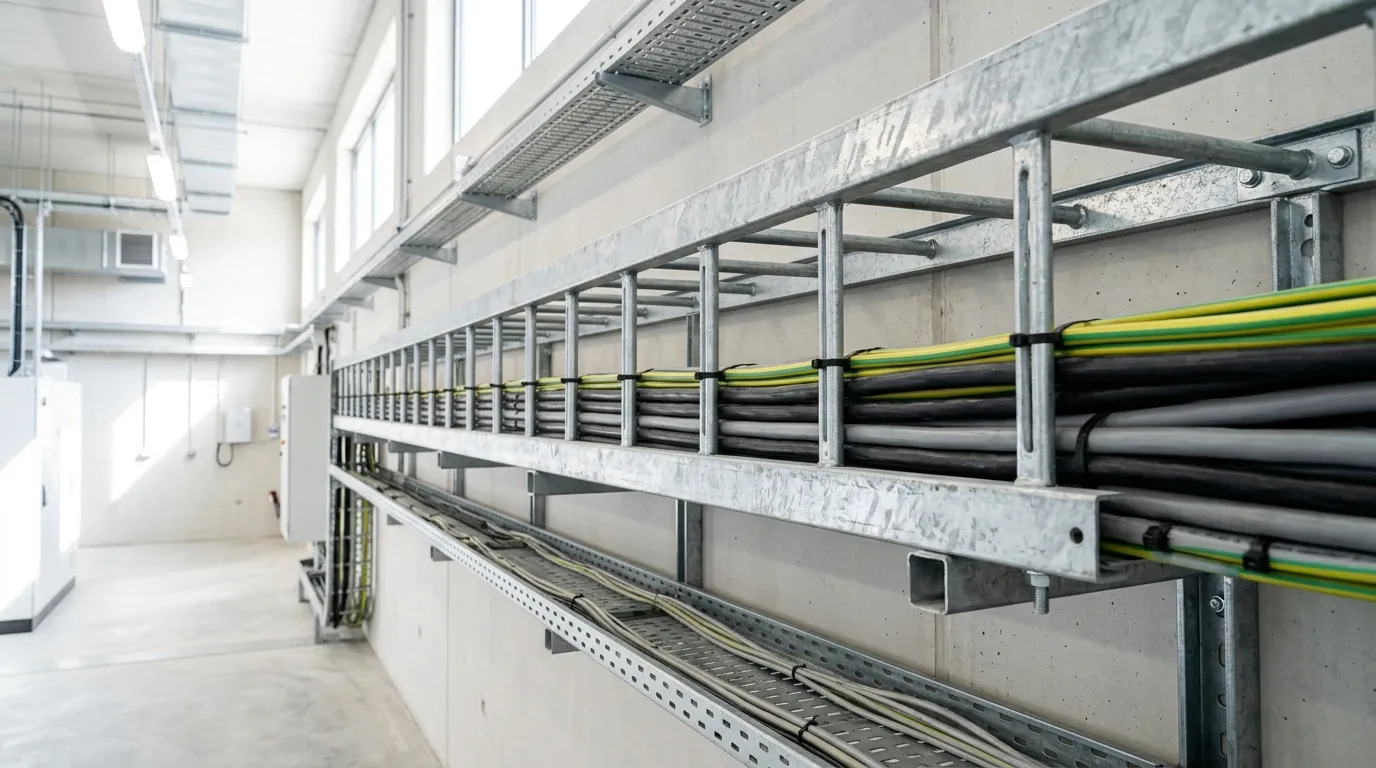
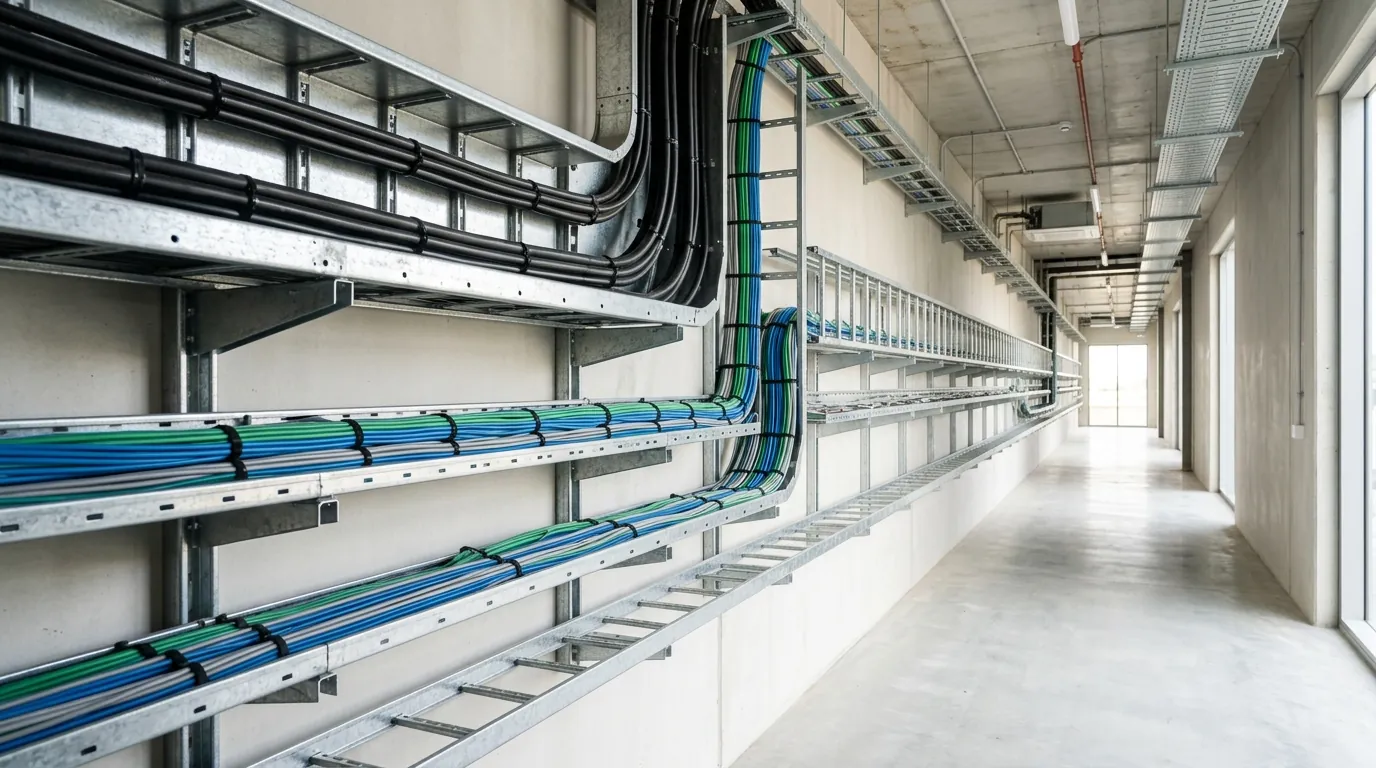
- Vertical separation in a stacked configuration. Trays stacked on a common support, one category per tier, with the tiers spaced apart. Power and data on the same vertical run, but never sharing a tray, and with air gap between them.
- Dedicated cable trunking for a life-safety route. Cable trunking is a four-sided enclosure. For a fire-alarm or emergency-lighting circuit that needs its own physically separated, enclosed route, a dedicated trunking run gives that circuit a continuous boundary on all four sides — separated from, and independent of, the general power and data routes.
- Colour-coded finish for circuit identification. Metosu powder coating is available in any RAL colour. Specifying a different colour per circuit category — one for power, one for data, one for life-safety — makes the segregation visible. An installer can see at a glance which tray a cable belongs in, and an inspector can verify the layout without tracing every run.
These techniques combine. A common pattern is dedicated ladders for power, a separate tray for data, and dedicated trunking for the life-safety route — with colour-coding so the intent survives long after the designer has left the project.
How to specify and verify it
Segregation that is not specified does not happen. It has to be designed in, drawn, and checked.
- State the segregation requirement in the specification. Name the circuit categories, state that they are to be carried on separate routes, and reference the project EMC/cabling specification and the applicable standard for the required power-to-signal separation. Do not leave the separation to be worked out on site.
- Show it on the layout drawings. Separate trays, divider positions, tier assignments in a stacked run, and the dedicated life-safety route should all be visible on the coordination drawings — not implied.
- Specify the identification. If circuit categories are to be colour-coded, state the colour per category so the powder-coat finish can be ordered correctly and the site team installs to a known scheme.
- Verify on inspection. Confirm on site that categories are where the drawings put them, that separation is maintained along the full run including at bends and intersections, and that the life-safety route is genuinely dedicated. The expensive failures are the ones found after handover.
A separated installation costs a little more in tray, support, and route space. A mixed one costs more in interference troubleshooting, in rework after a failed review, and — for life-safety circuits — in a risk that does not show up until the day it matters.
Talk to the Metosu technical team
Metosu manufactures cable tray, cable ladder, and cable trunking for segregated installations, with hot-dip galvanised and Jotun powder-coat finishes — powder coating available in any RAL colour for circuit-category identification. We can help match products and finishes to a project’s segregation scheme.
Email marketing@metosu.com or contact the Metosu technical team.
Further reading
- Cable trunking: when to enclose a cable route — choosing an enclosed route for circuits that need one
- Cable ladder vs cable tray — choosing the right system for each category
- Cable tray thermal derating — why grouping power cables affects current capacity
- Cable tray earthing and bonding — the tray as part of the electrical system
- Cable tray · Cable trunking · Full catalogue (PDF)