TL;DR
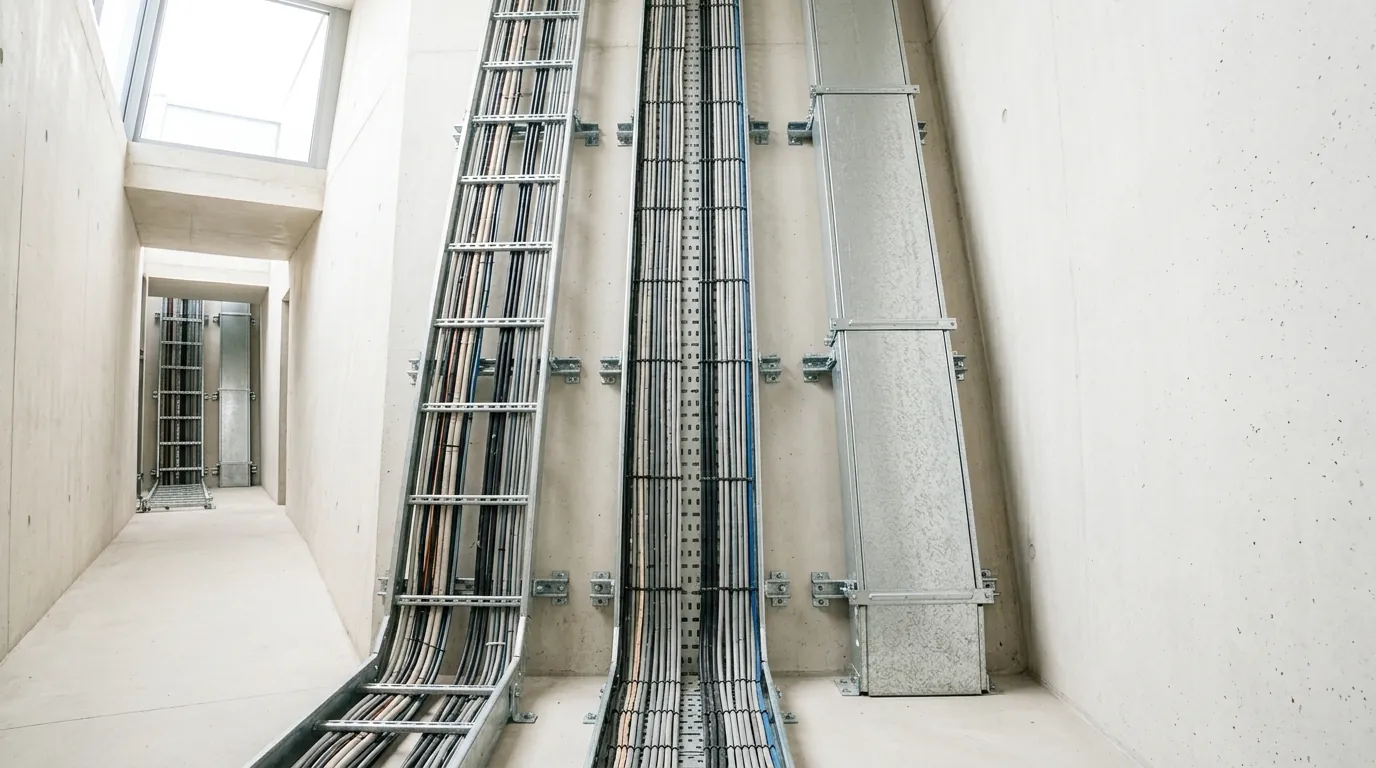
Three systems, three distinct use cases:
| System | Geometry | Metosu rating | Primary use |
|---|---|---|---|
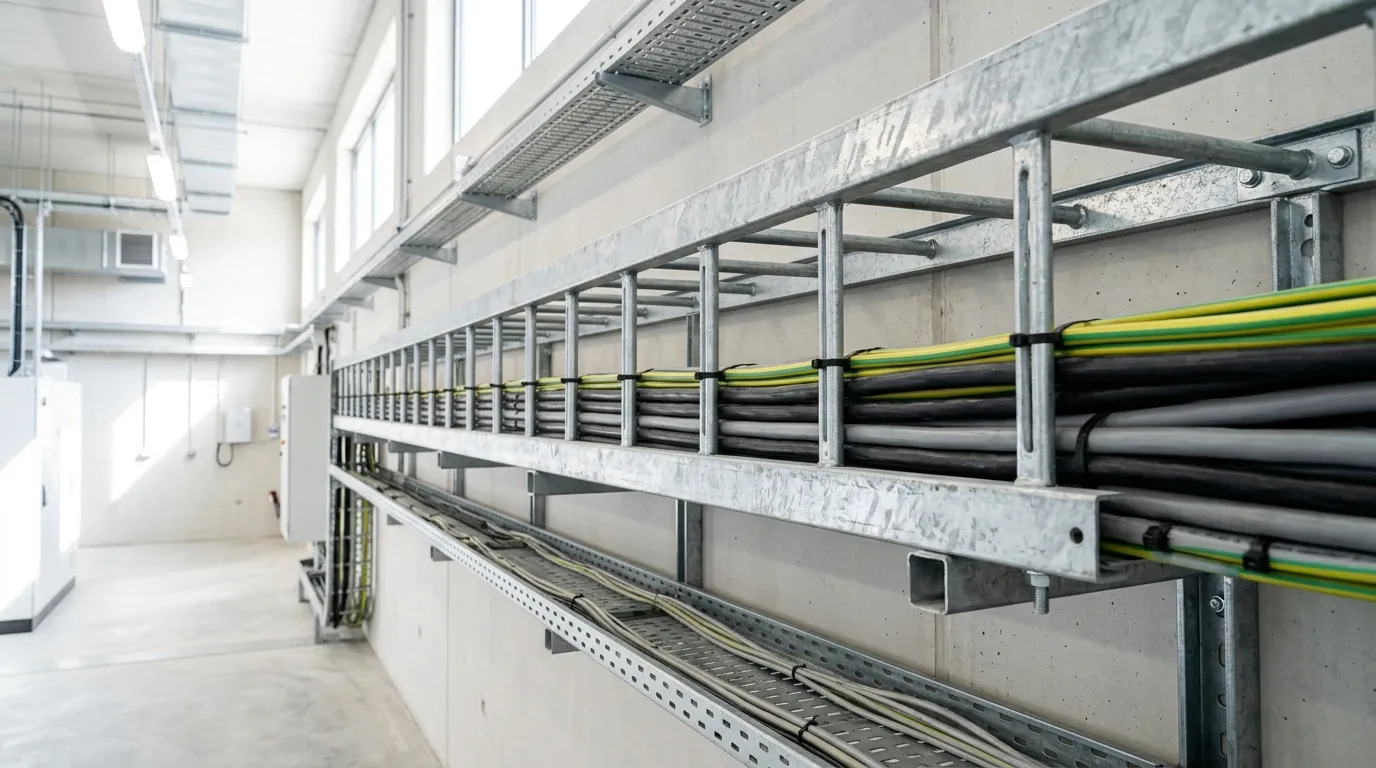
| Cable ladder | Two side rails + transverse rungs | 1,340 kg/span · NEMA Class 8C | Heavy power runs, long spans, open industrial routes |
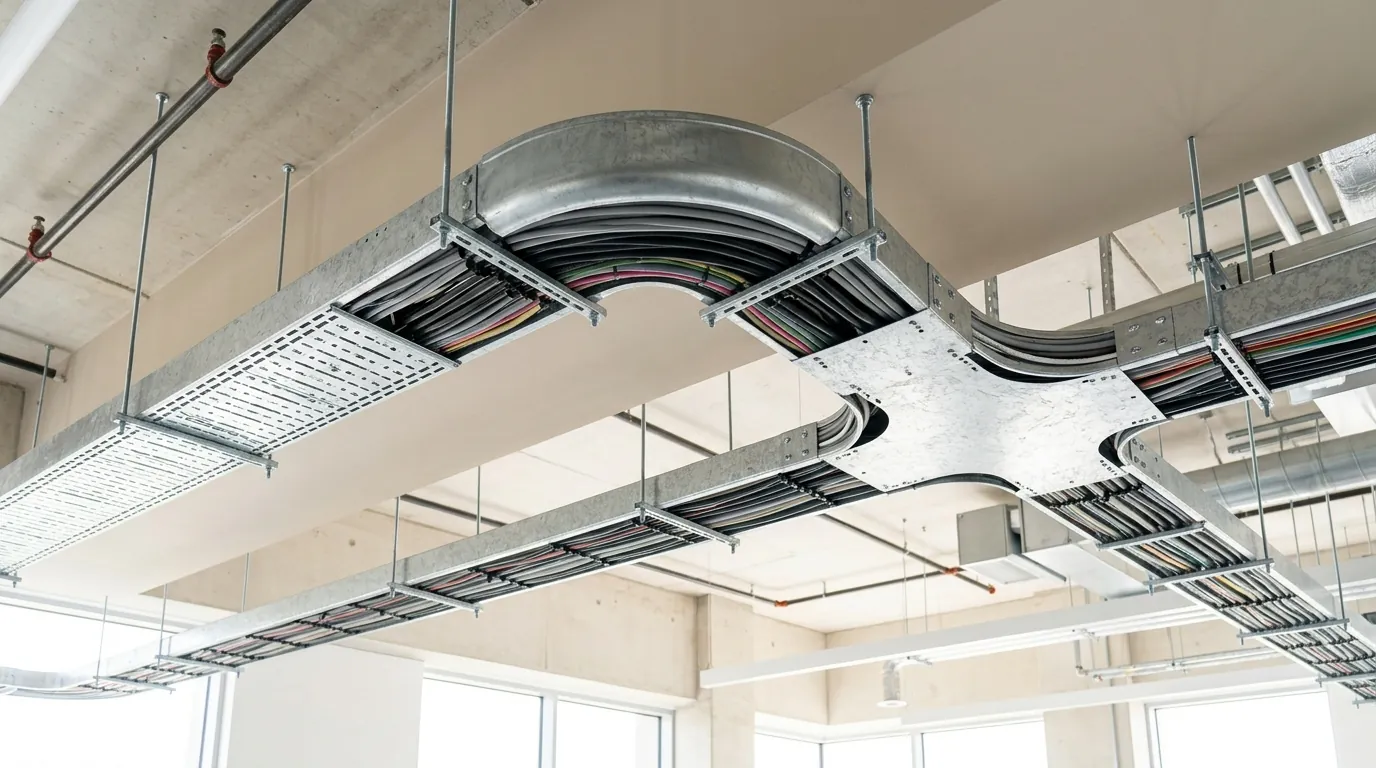
| Cable tray | Perforated channel, short sidewalls | 420 kg/span · NEMA Class 8B | Mixed LV power + data, architectural service voids |
| Cable trunking | Enclosed rectangular duct + cover | Full enclosure (not deflection-rated) | Small-diameter wiring, visible runs, safety circuits |
Both load ratings are independently tested by Sucofindo (via IDSurvey) against NEMA VE 1-2017 / CSA C22.2 No. 126.1-17, both tested at 2,400 mm support span, both at 14 July 2025:
- Ladder: SLU W600×H100×L3000, 1.95 mm steel. Held 1,340 kg before sample damage. NEMA Class 8C minimum is 534.4 kg — the ladder carries 2.5× the Class 8C requirement. Report E26929/FNBPAS.
- Tray: TRU W300×H100×L3000, 2.02 mm steel. Held 420 kg before damage. Class 8B minimum is 403 kg. Report E26933/FNBPAS.
Deflection limit for both = L/250 = 9.6 mm at the 2,400 mm span (the industry standard for permanent-load cable containment).
The specification decision then turns on four questions: how heavy is the cable load, how small are the cables, do different circuit types need segregation, and how visible is the run? Below — how we answer each one.
The three systems, in one paragraph each
Cable ladder
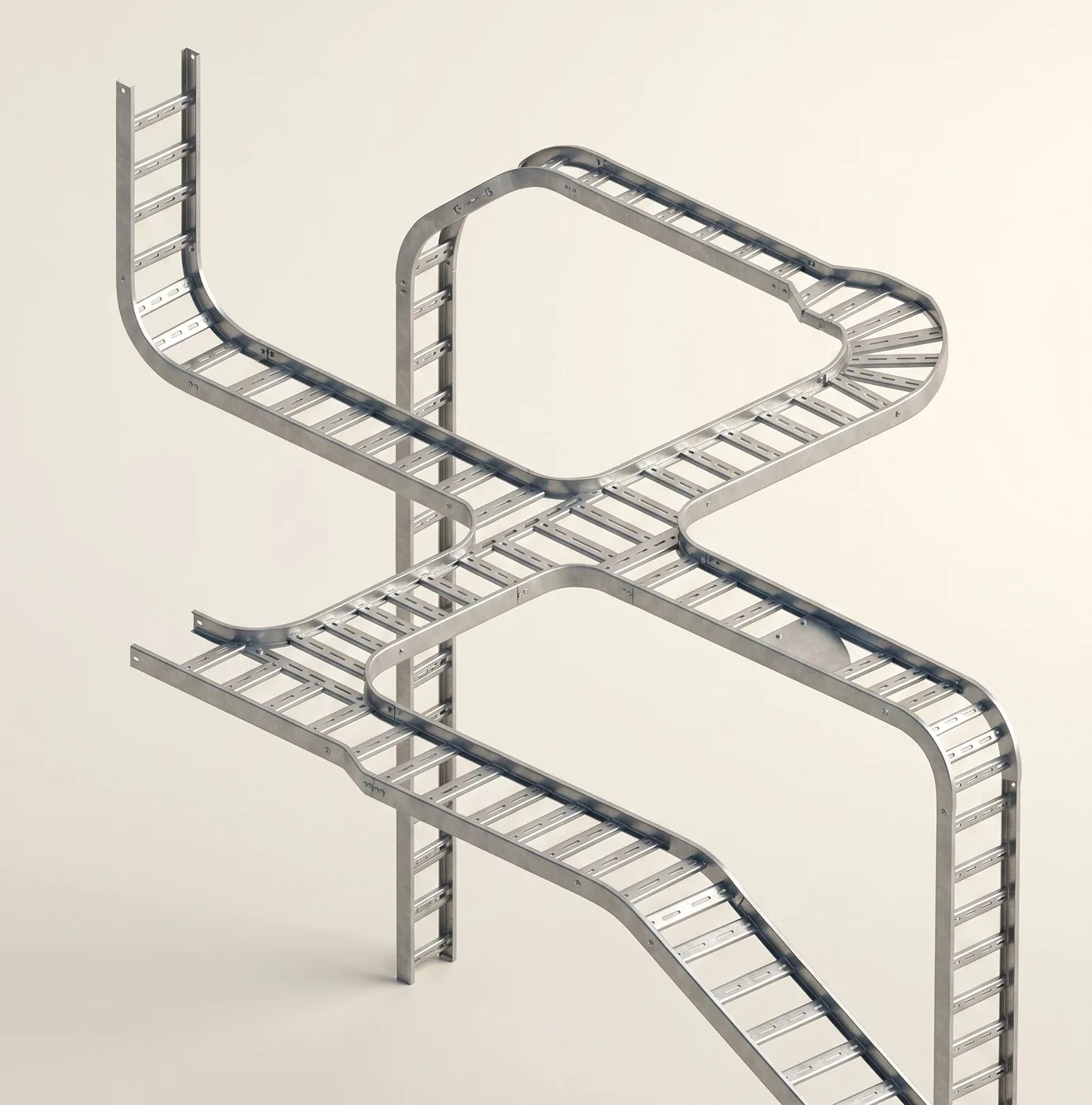
Two longitudinal side rails, transverse rungs at 150 mm or 300 mm spacing. Open geometry: you can see through it, air moves through it, you can walk on it for maintenance. Load-bearing element is the side rail profile — ladder is a structural member first, a cable carrier second.
Metosu’s line: SLW (perforated) and SLU (non-perforated), both in widths from 75 mm up to 1,200 mm, standard 3,000 mm lengths, in 1.2–3.0 mm hot-dip galvanised steel.
Cable tray
A pressed-and-welded steel channel with short upturned side rails (the “flange”) and a perforated or solid base. The side rails handle the rigidity; the base handles the cable. Widths 100–900 mm, depths 50–150 mm, lengths 2,400 or 3,000 mm, material 1.0–3.0 mm.
Metosu’s line: TRC (perforated, ventilated) and TRU (non-perforated).
Cable trunking
A fully enclosed rectangular channel with a removable cover — plain, perforated, or hinged. Unlike tray and ladder, trunking has four sides of mechanical protection. Cables enter through knock-out apertures; the cover seals the run.
Metosu’s line: TKC (perforated cover) and TKU (solid cover), widths 50–600 mm.
For completeness: wire mesh / basket tray is a fifth system (welded wire grid, popular for structured cabling and fibre). Metosu doesn’t currently ship a wire-mesh line.
The NEMA Class framework, simplified
NEMA VE 1-2017 (and the joint CSA C22.2 No. 126.1-17) is the standard engineers cite when they write “rated to Class 8C” on a drawing. The framework is compact:
- First digit = support span, in feet. 8 ft = 2.4 m, 12 ft = 3.6 m, 16 ft = 4.8 m, 20 ft = 6.0 m.
- Letter = working load per metre. A = 74.4 kg/m, B = 111.6 kg/m, C = 148.8 kg/m.
So Class 8C = a 2.4 m support span carrying 148.8 kg per linear metre (roughly 357 kg total over the span, well under our tested 1,340 kg capacity). Each higher class increases either the span or the per-metre load.
Metosu’s ladder is Class 8C at 2.4 m — the highest working-load class at the standard span. Our tray is Class 8B at 2.4 m. Both are load-tested to the NEMA VE 1 method by Sucofindo, and both meet or exceed the minimum damage-free load for their class by a meaningful margin.
For wider spans, the maximum working load per metre decreases. We publish the full span/load table per SKU in PART II of the catalogue.
Decision 1 — how heavy is the load?
The first question that settles most specifications:
- Heavy power runs (HV armoured feeders, motor drives, copper distribution over 50 kg/m): ladder. The 8C rating is the benchmark for data-centre and industrial power distribution. Wide spans between supports, fewer hangers, faster install.
- Mixed LV power plus data (commercial towers, hospitality, cleanroom-adjacent): tray. The 8B rating is comfortable for typical office-building loads, and the perforated base keeps cable heat out.
- Light wiring that needs protection, not load capacity (small-diameter control, safety circuits, visible architectural runs): trunking. Load rating is beside the point here — the product category exists to enclose, not to carry weight.
Rule of thumb: if your cumulative cable weight is over 50 kg per linear metre, specify ladder. Under that, either tray or trunking depending on how the run looks and what else it needs to do.
Decision 2 — how small are the cables?
Ladder geometry has one drawback: anything smaller than ~10 mm diameter can fall through the rungs if the spacing is 300 mm. For data cabling, fibre, or small control wire you either:
- Spec 150 mm rung spacing (available from Metosu on request), or
- Add a wire-mesh liner on top of the ladder, or
- Drop those cables into a tray below.
The most common solution in data centres is a stacked configuration: ladder above for the power feeders, tray below for data and control. That way each cable family gets the geometry it actually needs.
Small cables with heat derating concerns (parallel Cat 6A runs, fibre bundles) want tray’s ventilated base rather than trunking’s enclosed channel — airflow matters for ampacity.
Decision 3 — do different circuits need to be segregated?
IEC 60364-5-52 — the international low-voltage wiring standard — recognises four circuit families that benefit from physical separation:
- Safety circuits (fire alarm, emergency lighting)
- LV power
- Telecommunications / data
- Control and automation
For most projects the answer is one of three:
- Parallel runs — power in one ladder, data in another, ~200 mm apart. Standard in data centres and industrial plants.
- Single tray with barriers — a barrier strip bolted into the tray base divides it into separate compartments. Fine for lighter mixed loads.
- Enclosed trunking per circuit family — typical for safety circuits, which ship in their own colour-coded trunking so maintenance teams can identify them at a glance.
When the project brief calls for circuit-by-circuit physical isolation (hospital emergency power, nuclear/offshore life-safety), trunking is almost always part of the answer.
Decision 4 — how visible is the run?
Concealed runs — basement MEP, behind-ceiling service voids, riser shafts — optimise for cost. Galvanised ladder or tray, whichever handles the load, no powder coat, no architectural finish.
Visible runs — exposed service voids in offices, ceiling feature strips in hotel lobbies, open structures in industrial-chic retail — optimise for appearance. Metosu’s Jotun powder-coat line handles this: 60–80 µm build in any RAL colour, matched to the interior architect’s specification. Trunking often wins visible installations because the cover hides the cable-handling messiness (loops, transitions, service slack).
For outdoor and wash-down applications, trunking also wins on ingress protection — sealed covers can deliver IP40 or IP54, whereas open ladder and tray are inherently IP20 or lower.
Two standard finishes, both lines
Across the whole Metosu product range, every SKU ships in one of two finishes:
- Hot-dip galvanised (HDG) — to ISO 1461 as standard, with a heavier coat for marine and coastal. The default for industrial, outdoor, and heavy-service runs.
- Jotun powder-coated — 60–80 µm dry powder applied over a galvanised substrate. Any RAL colour. The default for visible architectural runs, hospitality, and clean-environment applications.
For marine and chloride-rich environments we spec heavier HDG to ISO 1461 as the tested alternative.
A real-world stack
In a typical Indonesian hyperscale data-centre build, all three Metosu product lines work in a layered configuration:
- Top tier — cable ladder, 600 mm width, Class 8C. Main redundant 3-phase power feeders from the PDU out to each rack row.
- Middle tier — cable tray (perforated), 300 mm width. Branch-circuit LV distribution and rack-level power taps.
- Bottom tier — cable trunking, 100 mm width, Jotun powder-coat white. Structured data cabling (Cat 6A, multimode fibre) and BMS/DCIM control loops, segregated from the power runs above.
- Separate vertical run — trunking in red, dedicated to fire-alarm and emergency-power circuits per the building’s life-safety plan.
Total vertical containment thickness above the rack: ~450–600 mm. Every section ships pre-tagged and bundled for the contractor’s install sequence.
Common misspecifications
-
Ladder where tray is correct. A data-only or light LV run specified at Class 8C ladder is paying for load headroom that will never be used. Tray at half the material cost installs faster and carries the real load without deflection.
-
Tray where trunking is correct. An exposed office-ceiling run with mixed power + data on an open tray looks unfinished, fails the IEC 60364-5-52 segregation test without barriers, and offers no mechanical protection. Trunking is the right category.
-
Trunking where ladder is correct. A 50 kg/m feeder in enclosed trunking hits thermal derating immediately and has to be oversized to compensate. Ladder with open airflow keeps the cable at rated ampacity.
-
300 mm rungs + small cable. Specifying a 300 mm rung spacing for a run that includes Cat 6A (7.8 mm diameter) means cables need to be tied every span or they fall through. Use 150 mm rungs, add a liner, or move the cable to a tray.
-
Mismatched substrate and finish. HDG tray with pre-galvanised fittings is not uniformly HDG — corrosion performance is set by the weakest link. Metosu ships matched substrate + finish across every fitting in a bundle; if fittings come from multiple vendors, write the spec carefully.
-
Ignoring IP on outdoor installations. Open ladder and tray don’t meet IP21, let alone IP40. For outdoor or wash-down zones the answer is trunking with sealed covers, or cable glands into an enclosed system.
How Metosu specifies
Every project dossier includes:
- Sucofindo load test reports — E26929/FNBPAS for ladder (Class 8C, 1,340 kg), E26933/FNBPAS for tray (Class 8B, 420 kg). Both tested 14 July 2025, issued 18 July 2025.
- Material certificates per heat, traceable to the mill.
- NEMA VE 1 / IEC 61537 compliance declarations with the specific class achieved.
- Span tables keyed to the specified finish, substrate, and cable fill.
For consulting engineers who have worked with us before, these arrive by default. For new projects, the documentation is part of the standard shipment envelope.
When to call engineering
Our engineering team reviews cable-management specifications as a pre-sales service. Send a single-line diagram, a cable schedule, and the project location — we’ll recommend the ladder/tray/trunking mix, substrate, finish, and support spacing, typically within one business day.
Email marketing@metosu.com or message us on WhatsApp.
Further reading
- NEMA VE 1-2017 / CSA C22.2 No. 126.1-17 — the North American metal cable tray standard and source of the load class framework.
- IEC 61537:2023 — the international standard for cable tray and ladder systems.
- IEC 60364-5-52 — low-voltage wiring selection and erection, covering cable sizing and circuit segregation.
- Metosu cable ladder · Metosu cable tray · Metosu cable trunking
- Catalogue download (EN) · (ID)