TL;DR
Trunking is the right pick when the cable run needs one or more of these:
| Requirement | Why trunking wins |
|---|---|
| Mechanical protection | Four-sided enclosure shields cables from impact, abrasion, and rodents |
| Circuit segregation | Dedicated enclosed channel per circuit family — IEC 60364-5-52 compliant out of the box |
| IP rating | Sealed covers achieve up to IP54; open tray and ladder sit at IP20 or lower |
| Visual finish | Cover hides cable messiness — loops, transitions, service slack — on exposed runs |
| Small-diameter wiring | Control wire, fire alarm, and data cables stay contained without ties or liners |
If none of these apply and the run is concealed with moderate-to-heavy cable load, open tray or ladder is cheaper and thermally better. Trunking is an enclosure product, not a structural load product.
What trunking actually is
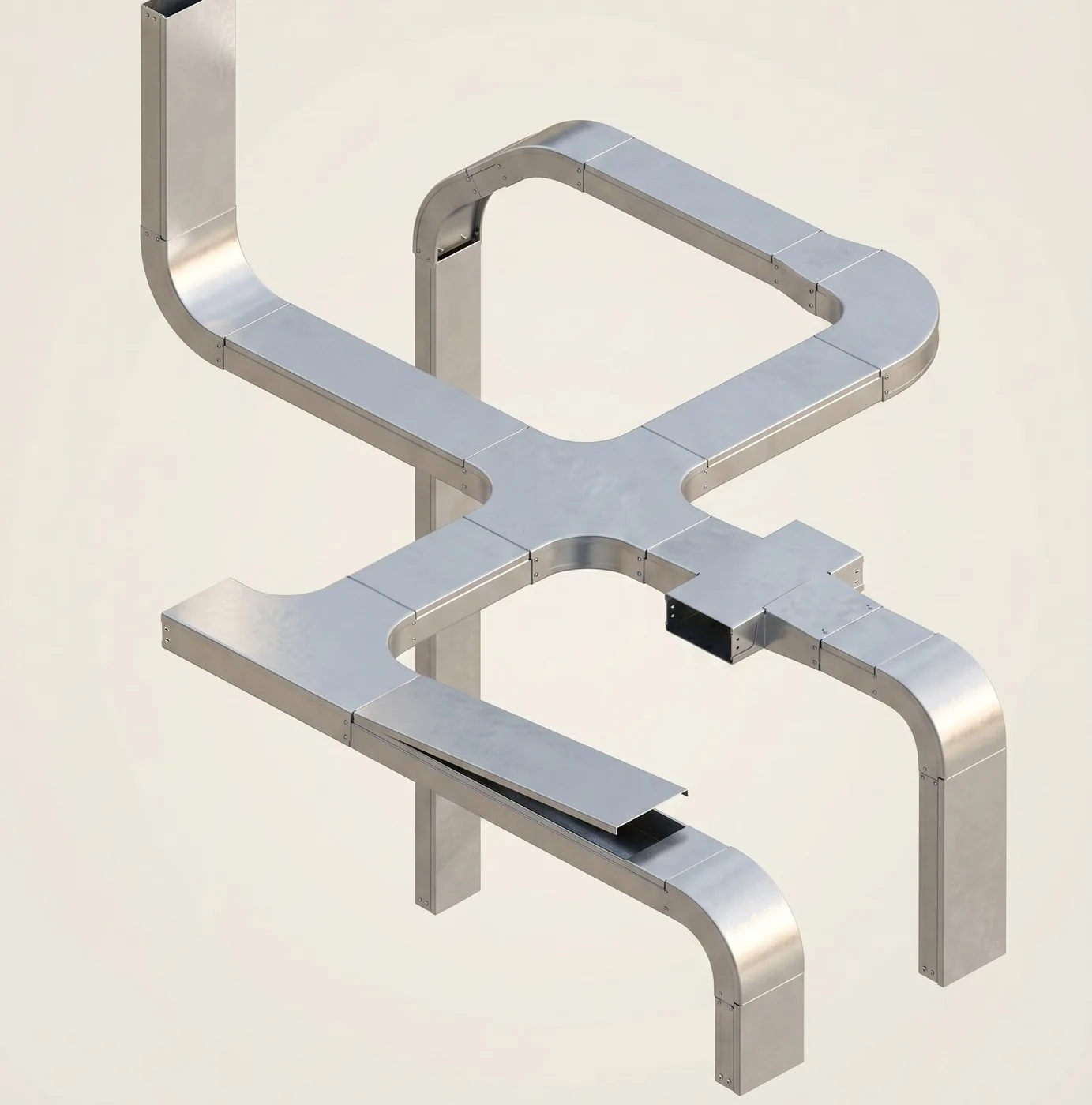
A fully enclosed rectangular steel channel with a removable cover. Cables enter through knock-out apertures in the sides or base; the cover snaps or screws shut to close the run.
Metosu manufactures two trunking lines:
- TKC — perforated cover. Allows limited ventilation while still providing mechanical protection. Typical for indoor control-wiring runs where heat dissipation matters.
- TKU — solid cover. Full enclosure for maximum protection and IP performance. The default for safety circuits, outdoor installations, and architectural runs.
Both lines ship in widths from 50 mm to 600 mm (50, 75, 100, 150, 200, 250, 300, 400, 500, 600), depths from 50 mm to 150 mm (50, 75, 100, 150), and material thickness from 1.0 mm to 2.5 mm steel. Cover variants include plain, perforated, and hinged.
Finishes: hot-dip galvanised (HDG) for industrial and outdoor service, or Jotun powder coat (60–80 µm build, any RAL colour) for visible and architectural runs.
When to specify trunking
1. Safety circuits — fire alarm, emergency lighting
IEC 60364-5-52 calls for physical separation of safety circuits from general power and data. In practice, most consulting engineers specify dedicated trunking — often colour-coded red or orange — for fire alarm and emergency lighting wiring. The enclosure does three things at once: mechanical protection against accidental damage, clear visual identification for maintenance teams, and physical isolation from other circuit families.
This is the single most common trunking application in Indonesian commercial and institutional buildings.
2. Visible architectural runs
Exposed-service interiors — offices with open ceilings, hotel lobbies, industrial-chic retail — need cable containment that looks intentional. Open tray shows every cable tie, every loop of service slack, every transition fitting. Trunking hides all of it behind a clean cover.
Metosu’s Jotun powder-coat line handles the aesthetics: specify any RAL colour to match the interior architect’s palette. The 60–80 µm build is robust enough for indoor service without additional treatment.
3. Outdoor and wash-down zones — IP rating
Open cable tray and ladder are inherently IP20 or lower. They offer no protection against water ingress, dust, or directed spray. For outdoor routing, wash-down areas in food processing, or any zone where the cable run is exposed to weather, trunking with sealed covers can achieve up to IP54 — protection against dust ingress and splashing water from any direction.
IP54 is not standard out of the box. It requires sealed cover variants and gasketed fittings — specify this on order and our engineering team will confirm the achievable rating for the selected cross-section and fitting configuration.
4. Small-diameter control wiring
Cables under ~10 mm diameter (Cat 6A at 7.8 mm, fire alarm cable, BMS control wire, thermocouple leads) fall through standard 300 mm ladder rungs and sit loosely in perforated tray without mechanical protection. Trunking contains them fully. No cable ties, no mesh liners, no secondary retention.
For runs where thermal derating is a concern — dense parallel data cables, for example — the TKC perforated-cover variant provides ventilation while still keeping the cables physically contained.
5. Circuit segregation per IEC 60364-5-52
The standard recognises four circuit families that benefit from physical separation: safety circuits, LV power, telecommunications/data, and control/automation. Trunking gives each family its own enclosed compartment by default — no barrier strips, no shared airspace.
In hospitals, data centres with life-safety requirements, and any project where the inspector will check segregation at handover, dedicated trunking per circuit family is the cleanest path to compliance.
Trunking vs conduit — when enclosure isn’t enough
Rigid or flexible conduit is the other enclosed cable-management option. The decision between trunking and conduit usually comes down to scale and access:
| Factor | Trunking | Conduit |
|---|---|---|
| Cable count | Multiple cables per channel | Typically 1–4 cables per run |
| Access for maintenance | Removable cover — open, re-route, close | Pull cable through, or cut and replace |
| Routing flexibility | Straight runs with standard fittings (bends, tees, risers) | Can route around obstacles, through tight spaces |
| Cost at scale | Lower per-cable for multi-cable runs | Lower for single-cable point-to-point |
| IP rating | Up to IP54 with sealed covers | Up to IP68 with sealed glands |
Rule of thumb: if the run carries more than three cables along the same route and will need periodic access for adds or changes, trunking is more practical and cheaper per cable. If the run is a single cable through a congested space or needs IP68, conduit wins.
What trunking is NOT
Trunking is an enclosure product. It is not deflection-rated like cable ladder (NEMA Class 8C, 1,340 kg/span) or cable tray (NEMA Class 8B, 420 kg/span). Do not specify trunking for heavy power feeders where structural load capacity is the primary requirement. A 50 kg/m armoured feeder in enclosed trunking will hit thermal derating limits and require cable oversizing — ladder with open airflow is the correct choice.
Similarly, trunking is not the right product for long unsupported spans. Support brackets should be spaced per the catalogue’s recommendation for the selected cross-section and cable fill.
Metosu trunking specs at a glance
| Parameter | Value |
|---|---|
| Product lines | TKC (perforated cover), TKU (solid cover) |
| Widths | 50, 75, 100, 150, 200, 250, 300, 400, 500, 600 mm |
| Depths | 50, 75, 100, 150 mm |
| Material | 1.0–2.5 mm steel |
| Cover variants | Plain, perforated, hinged |
| Finish | HDG or Jotun powder coat (60–80 µm, any RAL) |
| IP rating | Up to IP54 with sealed covers (specify on order); standard is IP20 |
When to call engineering
Our engineering team reviews trunking specifications as a pre-sales service — including cross-section selection, IP rating confirmation, finish matching, and support spacing for your cable fill. Send a cable schedule and the installation environment; we’ll come back with a recommendation, typically within one business day.
Email marketing@metosu.com or WhatsApp +62 816 689 689.
Further reading
- IEC 60364-5-52 — circuit segregation standard referenced throughout this article
- NEMA VE 1-2017 — load class framework (Class 8C/8B) referenced in the comparison section
- Cable trunking — Metosu TKC and TKU product pages
- Cable ladder — for heavy structural runs (Class 8C, 1,340 kg/span)
- Cable tray — for mixed LV power and data (Class 8B, 420 kg/span)
- Catalogue download (EN) · (ID)