TL;DR
Cable tray and conduit do the same job — route cables from A to B — and they do it in opposite ways. Conduit is a sealed pipe carrying one circuit or a small group. Cable tray is an open support carrying many cables at once. Neither is “better”; the right choice is a system-level decision driven by how many cables you have, how likely the route is to change, how much access you need, how cables shed heat, how much mechanical protection the environment demands, and how installed cost behaves as the project scales.
| Dimension | Conduit | Cable tray |
|---|---|---|
| Cables carried | One circuit or a small group per run | Many cables on one support |
| Future change | Pull in, re-pull out — disruptive | Lay in or lift out — open access |
| Installation | Labour-intensive; cut, thread, bend | Faster at scale; cables laid in place |
| Heat dissipation | Enclosed — restricts airflow | Perforated tray allows airflow |
| Mechanical protection | Full enclosure | Open; cables exposed unless covered |
| Cost behaviour | Scales with every metre and bend | Lower cost per cable as count rises |
| Best for | Small fixed circuit counts, final drops | Many cables, distribution backbones |
What each system is
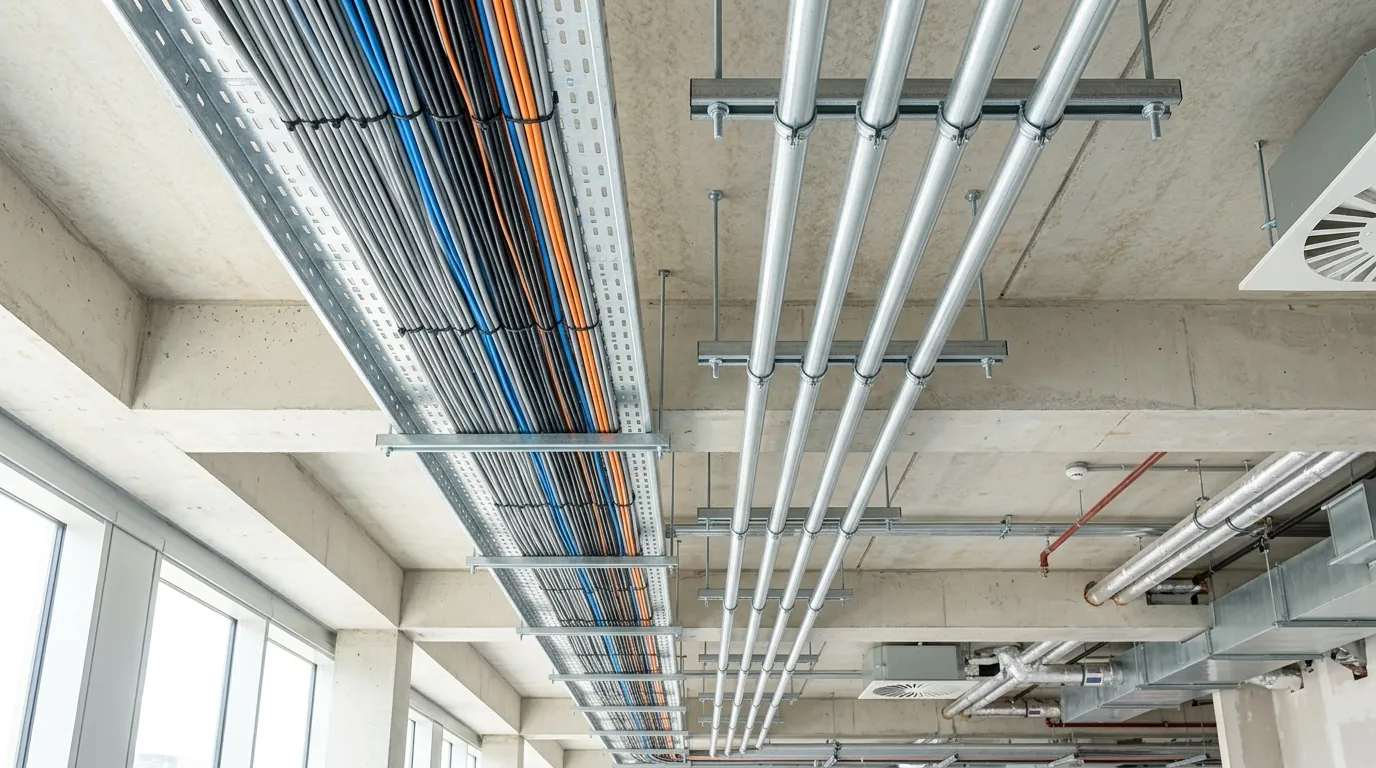
Conduit is a fully enclosed pipe — steel or PVC — that routes a single circuit or a small group of cables along one defined path. The cables sit inside, protected on all sides. Conduit gives full mechanical and environmental protection: nothing reaches the cable without first getting through the pipe. That protection is its defining strength. Its defining cost is labour — every run is cut, threaded or solvent-welded, bent or fitted, and then the cables are pulled through. Adding or changing a circuit later means another pull, and a full conduit cannot simply be re-loaded.
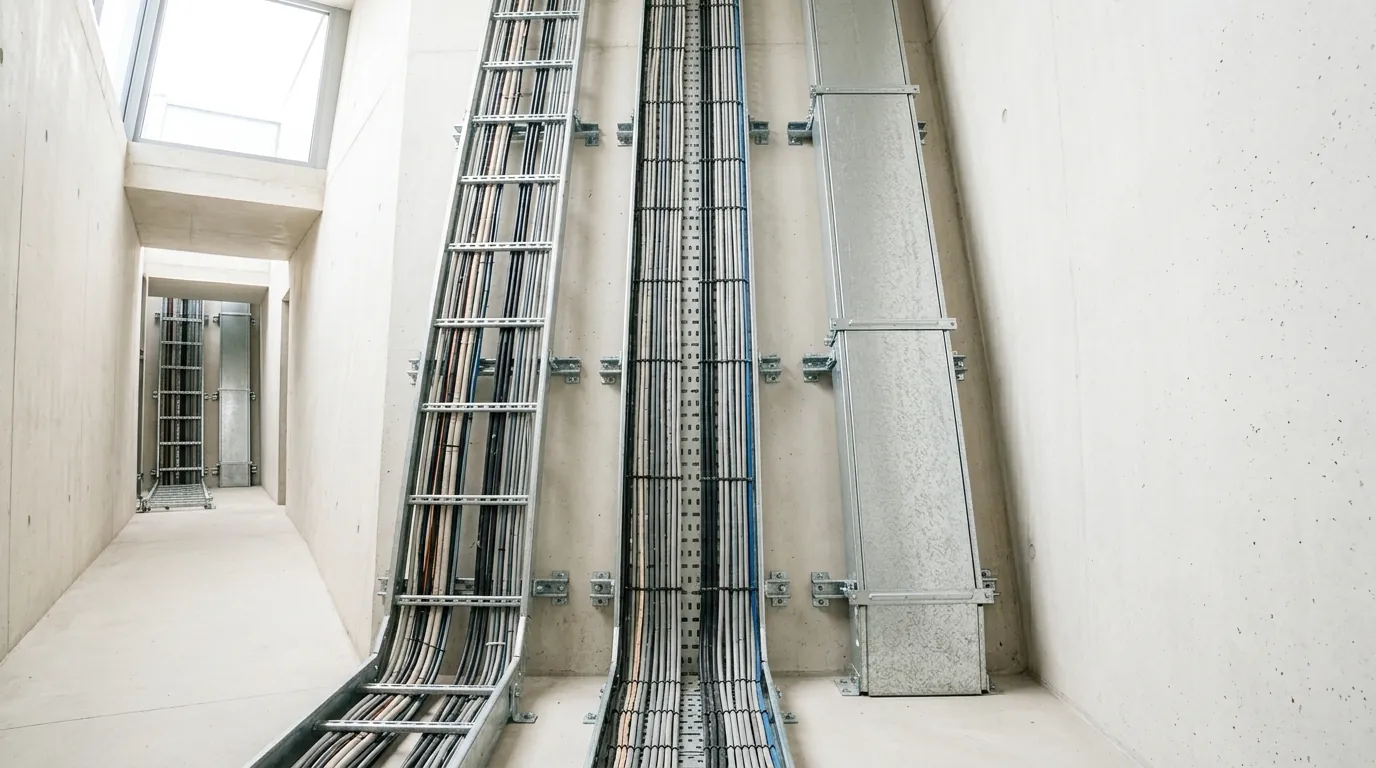
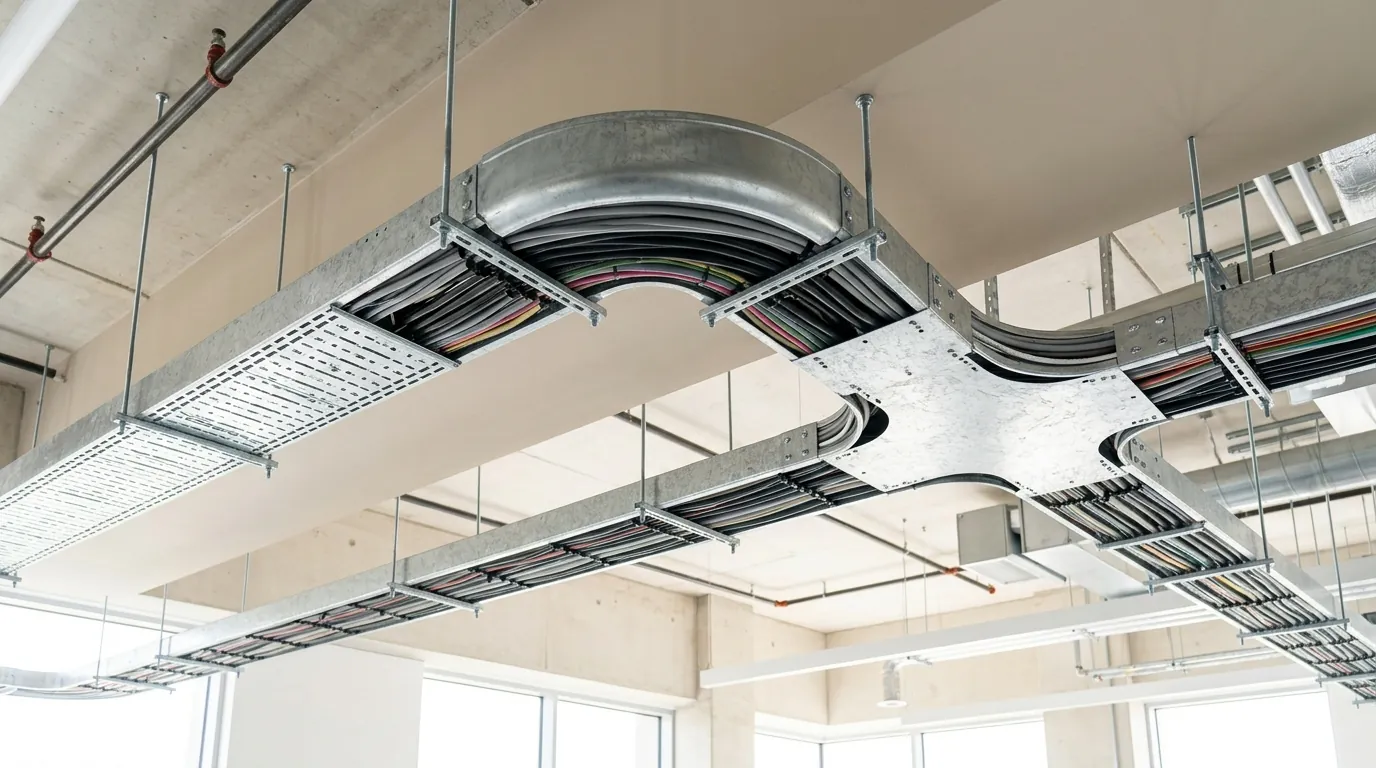
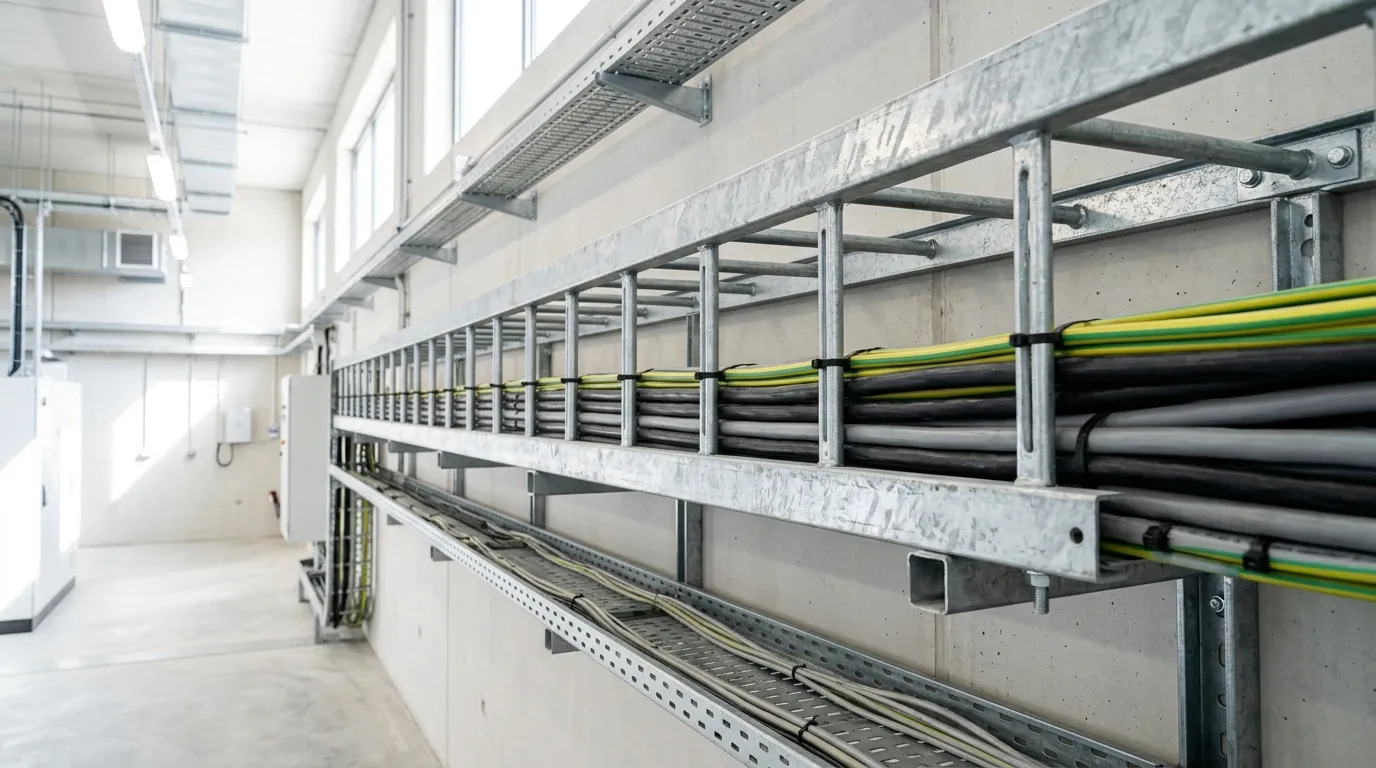
Cable tray and cable ladder take the opposite approach: an open support structure that carries many cables along a common route. Cables are laid into the tray rather than pulled through it. A cable tray (Metosu TRC perforated or TRU non-perforated) is an open support sized for many cables, with the perforated option allowing airflow around them. A cable ladder (Metosu SLW perforated or SLU non-perforated) is an open-rung structure built for heavy grouped power feeders and long runs — the format that carries the most weight over the longest spans. Both leave the cables visible and reachable.
Cable trunking sits between the two. Metosu trunking (TKC with a perforated cover, TKU with a solid cover) is a four-sided steel enclosure with a removable cover. It gives the full mechanical protection of an enclosure, but the removable cover means cables can be laid in and accessed without the pulling discipline of conduit. When the choice is not cleanly tray-or-conduit, trunking is often the answer.
The trade-off dimensions
The decision is rarely about one factor. It is about how five of them line up for a given route.
Cable capacity and future change. Conduit is fill-limited and route-fixed: each run is sized for its cables, and once installed it is hard to add to. Cable tray scales with cable count and stays open — cables can be added, removed, or re-routed by lifting a section of cover or simply laying in another circuit. If the route is a backbone that will grow over a building’s life, that openness is worth a great deal. If the circuit count is small and fixed, conduit’s rigidity is not a problem.
Installation speed and labour. Conduit is labour-intensive: measuring, cutting, threading or cementing, bending to fit the structure, then pulling cable. Cable tray and ladder are assembled as a support system and the cables are laid in — at scale, fewer labour hours per cable routed. The more cables share a route, the wider that gap.
Heat dissipation. Grouped current-carrying cables generate heat, and heat that cannot escape forces the cable to be derated — a larger, more expensive conductor for the same load. A fully enclosed conduit restricts airflow and traps heat around the cables. A perforated cable tray lets air move around the cables, which helps them run cooler. Where many power cables share a route, this is a real design factor, not a detail. (Tray thermal behaviour deserves its own treatment — see the further reading below.)
Mechanical and environmental protection. This is where conduit leads. A sealed pipe protects cables from impact, abrasion, dust, water, and rodents on every side. An open tray does not — exposed cables on an open tray rely on the environment being benign, or on a cover. Cable trunking closes most of that gap with its four-sided enclosure and removable cover; conduit closes all of it. Where the environment is hostile or full enclosure is mandated, that protection decides the choice on its own.
Cost behaviour as the project scales. For one or two circuits, conduit is cheap and quick. As cable count rises, conduit cost climbs with every metre, every bend, and every pull, while a single tray run absorbs more cables with little extra. There is a crossover point on every project: below it, conduit wins on cost; above it, cable tray does. Counting cables per route, rather than pricing fittings in isolation, is what locates that crossover.
When conduit is the right call
Conduit is the honest answer — and Metosu does not make it — in several clear cases:
- Small, fixed circuit counts. One or a few circuits on a route that will not grow. Here conduit is cheaper, faster, and the rigidity costs nothing.
- Final drops to equipment. The last stretch from a distribution route down to a motor, a panel, or a fixture. These are short, defined, single-destination runs — exactly conduit’s strength.
- Hostile or hazardous spots. Where cables face impact, abrasion, chemical exposure, washdown, or a classified hazardous area, the full enclosure of conduit earns its labour.
- Where full enclosure is mandatory. Some areas, occupancies, and client standards require cables to be fully enclosed. Where the specification or code says so, conduit (or solid trunking) is not a preference — it is the requirement.
When cable tray is the right call
Cable tray or cable ladder is the right call where the route is doing real distribution work:
- Many cables sharing a route. Once a route carries enough cables that a bank of conduits would be needed, the open support and the cost-per-cable both favour tray.
- Routes that will be added to or re-routed. Risers, plant rooms, and service corridors change over a building’s life. An open tray accepts those changes without re-pulling.
- Runs where heat dissipation matters. Grouped power cables that would be derated inside a sealed pipe run cooler on a perforated tray.
- Large distribution backbones and long runs. For heavy grouped power feeders over long spans, cable ladder is the format built for the load — Metosu’s SLW and SLU ladder is independently tested by Sucofindo to 1,340 kg per span, NEMA Class 8C; the TRC and TRU cable tray to 420 kg per span, NEMA Class 8B.
The hybrid approach
Most real buildings do not choose one system — they use a mix, matched route by route. The common pattern is straightforward: cable tray or cable ladder for the backbone, carrying the bulk of cables along risers, corridors, and plant rooms where capacity and future access matter most; and trunking or conduit for final drops and exposed or hostile sections, where the run is short, defined, and needs full enclosure.
Cable trunking is what makes the hybrid clean. It connects the open backbone to enclosed final circuits, gives full mechanical protection where the tray is exposed to traffic or impact, and keeps the access that pure conduit gives up. A well-designed installation is not “tray vs conduit” — it is tray and ladder where the cables are many and the route will change, trunking and conduit where they are few and the route is fixed, each chosen for what that section of the building actually needs.
Designed against IEC 61537 (cable tray and ladder systems), IEC 60364-5-52 (selection and erection of wiring systems), NEMA VE 1-2017, and PUIL 2011, a mixed system gives every route the right answer rather than forcing one answer onto every route.
Specify it route by route
If you are sizing a distribution design and want a second pair of eyes on where tray, ladder, or trunking fits — and where conduit is genuinely the better call — Metosu’s engineering team can help you work through it.
Email marketing@metosu.com or contact the Metosu technical team.
Further reading
- Cable ladder vs cable tray — choosing between the two open systems
- Cable trunking: when to enclose — the case for the four-sided channel
- Cable tray thermal derating — how heat dissipation changes conductor sizing
- Cable tray support spacing — span, deflection, and getting supports right
- Cable tray · Cable ladder · Cable trunking · Full catalogue (PDF)