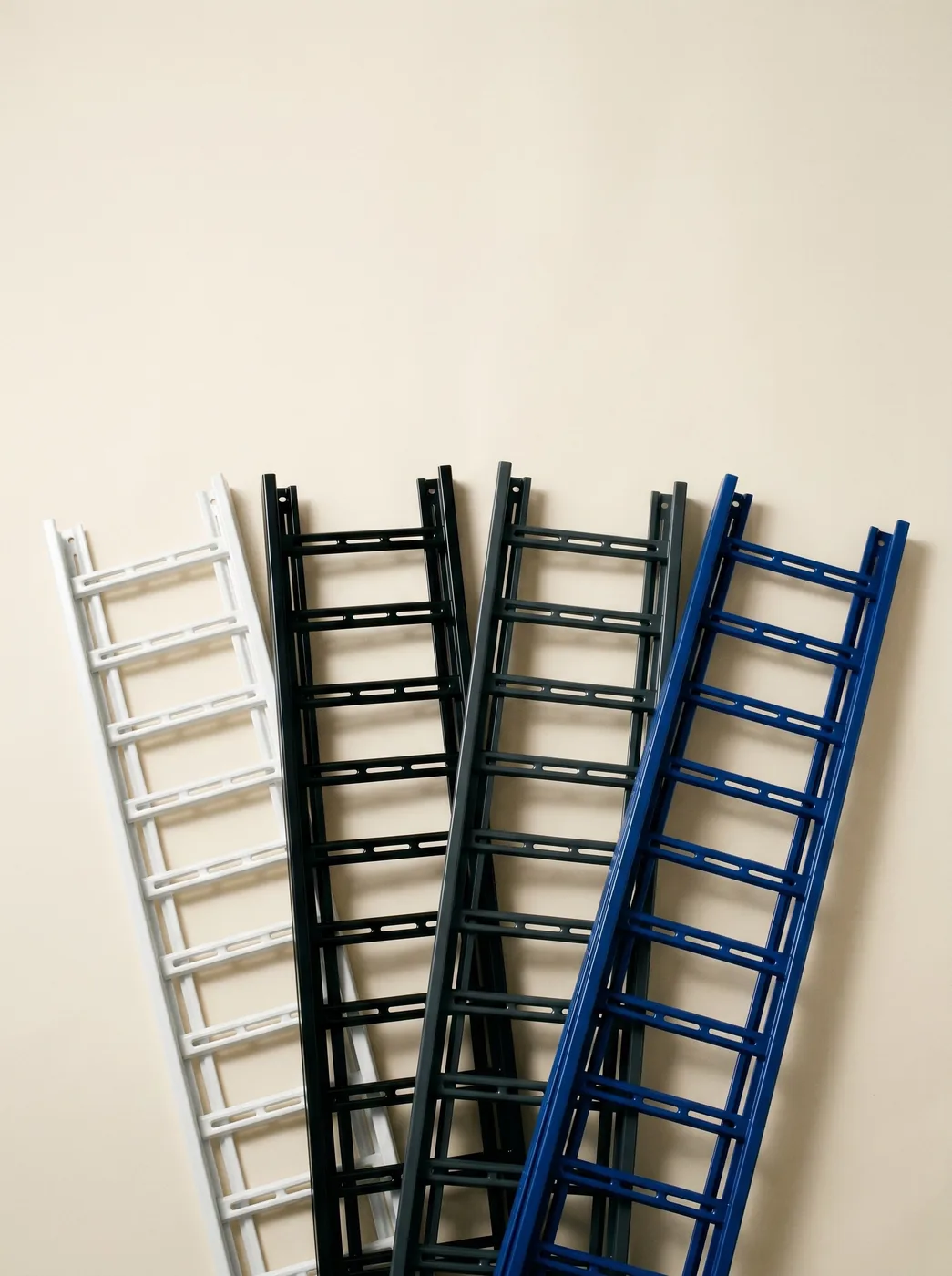
TL;DR
| Property | Hot-dip galvanised (HDG) | Jotun powder-coated |
|---|---|---|
| Chemistry | Molten zinc bath, metallurgical bond | Epoxy-polyester hybrid dry powder, Jotun AS (Norway) |
| Film build | To ISO 1461 · heavier coat for marine/coastal | 60–80 µm |
| Corrosion class | C3–C5M (per coating weight) | C3–C5M per ISO 12944 |
| Colour | Zinc silver-grey only | RAL 9010 default, any RAL on request |
| Cure | Ambient (post-dip air cool) | Oven-cured at 180 °C |
| Gloss retention | N/A (zinc patinas naturally) | >50 % after 1,000 h QUV per ISO 11507 |
| Best for | Industrial, outdoor, marine, heavy-service | Architectural, visible runs, colour-matched interiors |
Both finishes apply over the same steel substrate: 1.0–3.0 mm for tray, 1.0–2.5 mm for trunking, 1.2–3.0 mm for ladder. Pick based on environment first, aesthetics second.
What each finish actually is
Hot-dip galvanising (HDG)
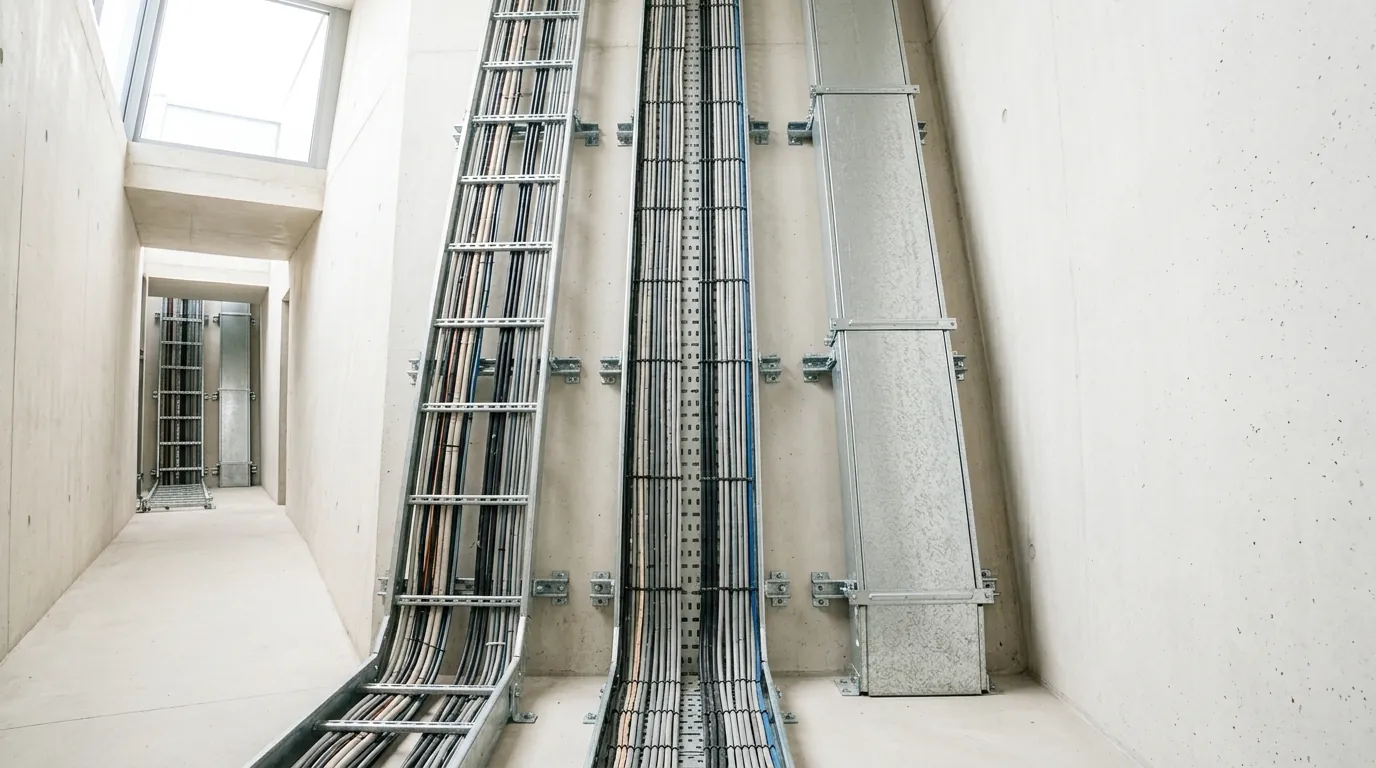
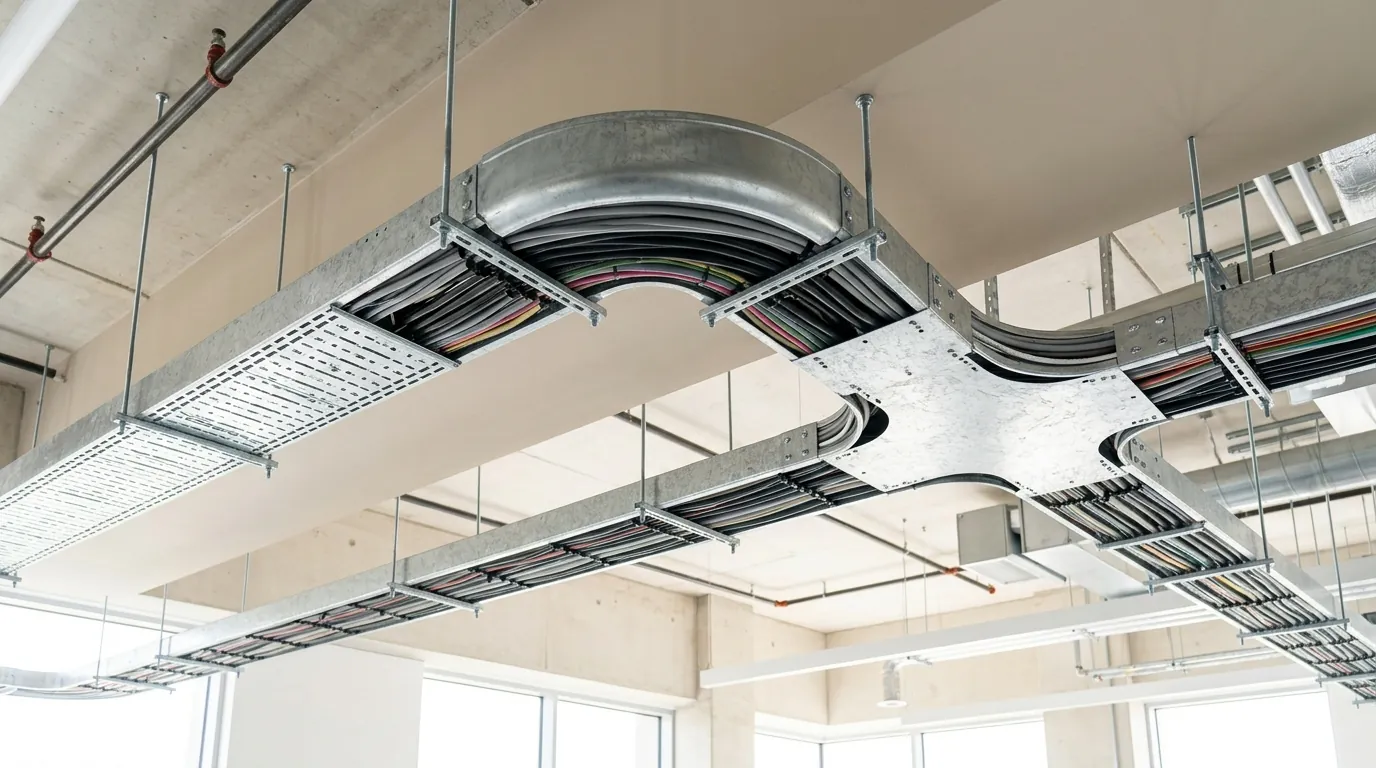
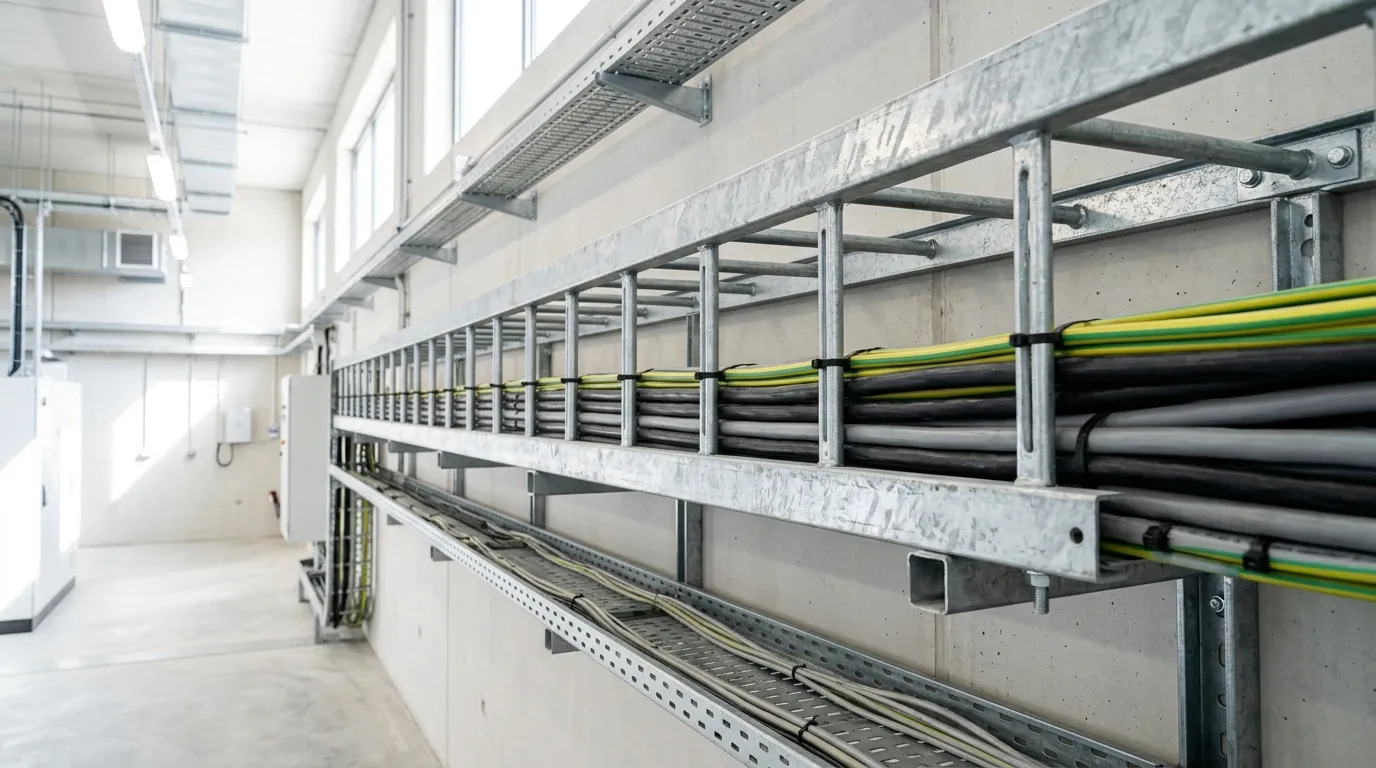
The finished steel part is submerged in a bath of molten zinc at ~450 °C. The zinc reacts with the steel surface to form a series of zinc-iron intermetallic layers topped by a pure zinc outer coat. The result is a metallurgical bond — the coating is not sitting on the steel, it is alloyed into it.
Metosu’s standard HDG is applied to ISO 1461 (hot-dip galvanising on fabricated iron and steel articles). For marine, coastal, and high-chloride environments we specify a heavier coat.
The zinc layer corrodes sacrificially — it protects the steel even when scratched, cut, or drilled on site. This is why HDG remains the default for cable management that will be handled roughly during installation and exposed to weather, chemicals, or salt air over a 20–30 year service life.
Jotun powder coating
Metosu uses Jotun epoxy-polyester hybrid dry powder — not liquid paint, not electrostatic wet spray. The powder is electrostatically applied to a clean, pre-treated steel surface, then oven-cured at 180 °C to form a continuous, cross-linked polymer film.
Key numbers:
- Film build: 60–80 µm
- Standard colour: RAL 9010 (pure white). Any RAL colour available on request.
- Corrosion resistance: rated C3 through C5M per ISO 12944 (paints and varnishes — corrosion protection of steel structures by protective paint systems).
- UV durability: gloss retention >50 % after 1,000 hours of accelerated weathering per ISO 11507 (QUV method).
The Jotun name matters. Epoxy-polyester hybrids vary widely between powder manufacturers; Jotun’s formulation gives a consistent balance of chemical resistance (from the epoxy component) and UV stability (from the polyester component) that cheaper single-resin powders cannot match.
When to specify HDG
HDG is the right finish when the cable management system will face:
- Outdoor exposure — rooftop runs, bridge racks, petrochemical pipe racks. Zinc’s sacrificial protection means cut edges and bolt holes are still protected.
- Marine or coastal environments — within 1 km of the coast, or any site with measurable chloride deposition. Specify the heavier marine-grade galvanised coat, to ISO 1461.
- Industrial atmospheres — chemical plants, smelters, cement works, fertiliser facilities. ISO 12944 corrosivity category C4 and above.
- Heavy handling during install — long ladder runs lifted by crane, tray sections dragged across structural steel. HDG tolerates mechanical abuse that would chip a powder coat.
- Concealed service routes — behind-ceiling voids, riser shafts, basement MEP corridors. No one sees the finish; HDG costs less than powder and performs better in uncontrolled humidity.
In Indonesia specifically, HDG is the default for data centres, industrial plants, power stations, and infrastructure projects where the specification is driven by the consulting engineer’s corrosion assessment, not the interior designer’s RAL chart.
When to specify powder coat
Powder coat is the right finish when:
- The run is visible — hotel lobbies, open-ceiling offices, retail fit-outs, hospital corridors. Colour-matching to the architectural specification is a hard requirement, and RAL 9010 (or any custom RAL) delivers it.
- The environment is indoor and climate-controlled — ISO 12944 category C1–C3. Corrosion stress is low; appearance drives the decision.
- Clean or hygienic environments — food processing, pharmaceutical, laboratory. The smooth polymer surface is easier to clean than the rough zinc texture of HDG. (Note: for wash-down zones with aggressive chemicals, confirm the specific Jotun powder’s chemical resistance datasheet.)
- Colour-coded circuit segregation — safety circuits in red trunking, data in blue, power in grey. Powder coat makes visual identification immediate for maintenance teams.
Powder coat over a galvanised substrate (duplex system) is also an option for projects that want both sacrificial zinc protection and a colour finish. Metosu can supply duplex on request — the HDG goes on first, then the powder. This adds cost but extends service life in aggressive environments where appearance also matters (e.g., coastal hotel MEP exposed in a car park).
The ISO 12944 corrosivity map
ISO 12944-2 defines six corrosivity categories. This is the framework that ties the finish decision to the project site:
| Category | Environment | Recommended finish |
|---|---|---|
| C1 | Heated interiors, low humidity | Powder coat (aesthetic choice) |
| C2 | Unheated interiors, rural outdoors | Powder coat or HDG to ISO 1461 |
| C3 | Urban/industrial interiors, coastal mild | HDG to ISO 1461 or powder coat (C3-rated) |
| C4 | Industrial, moderate coastal | HDG to ISO 1461 |
| C5-I | Aggressive industrial (chemical plant) | Heavier HDG to ISO 1461 |
| C5-M | Marine, offshore, high chloride | Heavier HDG to ISO 1461 |
For C5-M environments where even the heavier HDG coat is marginal, the next step is an engineering review of the specific atmosphere. Heavier HDG to ISO 1461 is our tested and stocked solution for marine and chloride-rich projects.
Site damage and field repair
This is where HDG has a structural advantage. A scratch through a powder coat film exposes bare steel — corrosion starts at the scratch and creeps under the surrounding film (filiform corrosion). A scratch through HDG exposes steel too, but the surrounding zinc corrodes sacrificially to protect the exposed area. The zinc “heals” small damage zones electrochemically.
For powder-coated systems installed in C3+ environments, Metosu recommends carrying a touch-up kit (Jotun-matched spray can or brush-applied epoxy) for any cuts, drills, or impact damage made during installation. This is standard practice per ISO 12944-8 (development of specifications for new work and maintenance).
HDG systems in the same environments typically need no field touch-up at all.
Cost and lead time
HDG is generally lower cost per square metre of finish than powder coat, because the process is a single dip rather than a multi-step clean-prime-spray-cure line. Lead times are comparable for standard orders — both finishes run through Metosu’s Tangerang facility.
Custom RAL colours on powder coat may add 3–5 working days to the standard lead time, depending on batch size and colour availability from Jotun’s regional stock.
The decision in one sentence
If you are choosing between HDG and powder coat and the environment is C3 or above, or the installation involves outdoor exposure, or the cable management will be handled roughly — specify HDG. If the run is visible, indoor, climate-controlled, and appearance matters — specify Jotun powder coat. When in doubt, HDG is the safer default.
For project-specific finish recommendations, email marketing@metosu.com with your site location, corrosivity assessment, and cable schedule. Our engineering team will confirm the right finish and coating weight.
Further reading
- Cable ladder · Cable tray · Cable trunking
- Catalogue download (EN) · (ID)
- ISO 12944 — Paints and varnishes, corrosion protection of steel structures
- ISO 1461 — Hot dip galvanised coatings on fabricated iron and steel articles
- ISO 11507 — Paints and varnishes, exposure to artificial weathering (QUV)