TL;DR
Three numbers decide whether a cable tray installation goes smoothly or triggers a change order:
- Width — sum of cable diameters across the tray, with spacing, plus a margin for future additions.
- Depth — single-layer is ideal; multi-layer is allowed but demands derating and careful stacking rules.
- Fill ratio — NEC Article 392 sets tray fill limits, and good design practice keeps power cables at 40–50 % of the tray cross-section. Data cables can push to 50–60 % because they generate less heat.
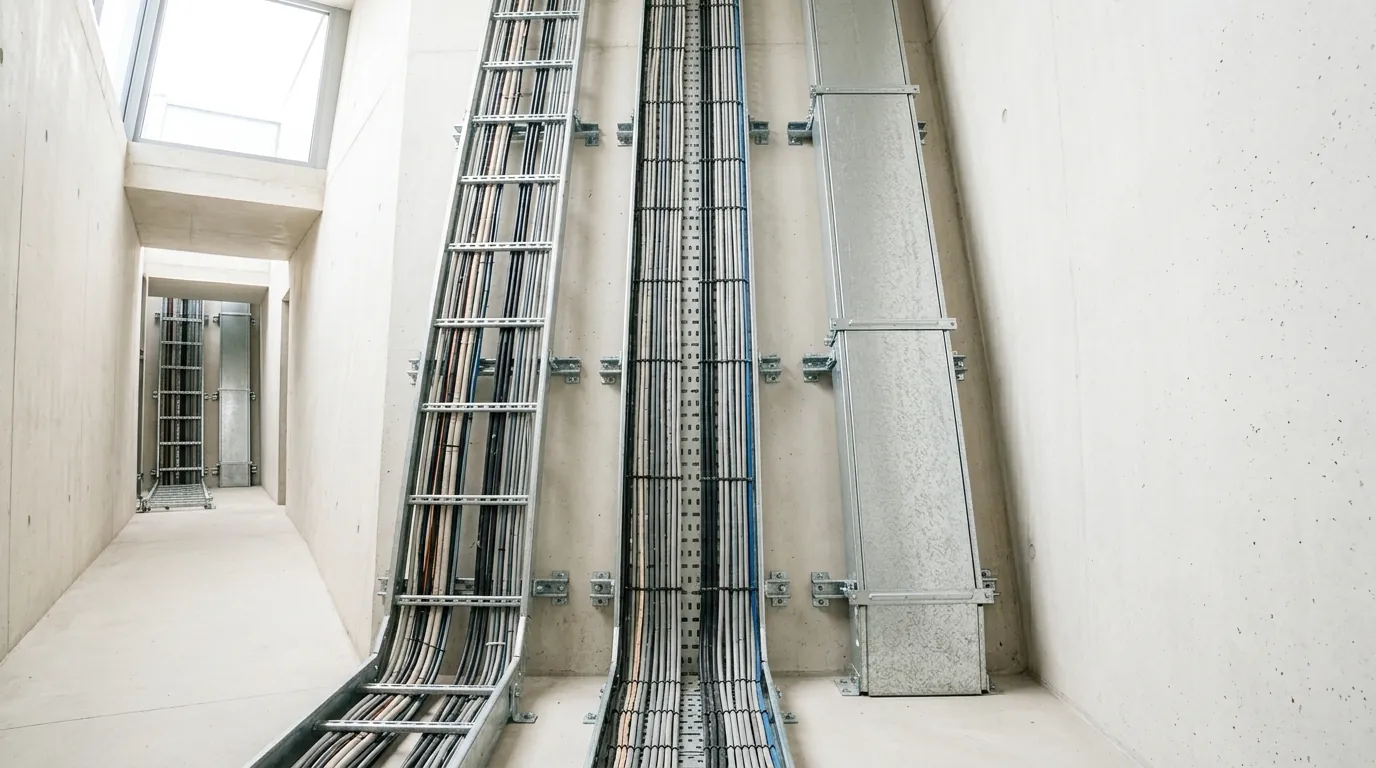
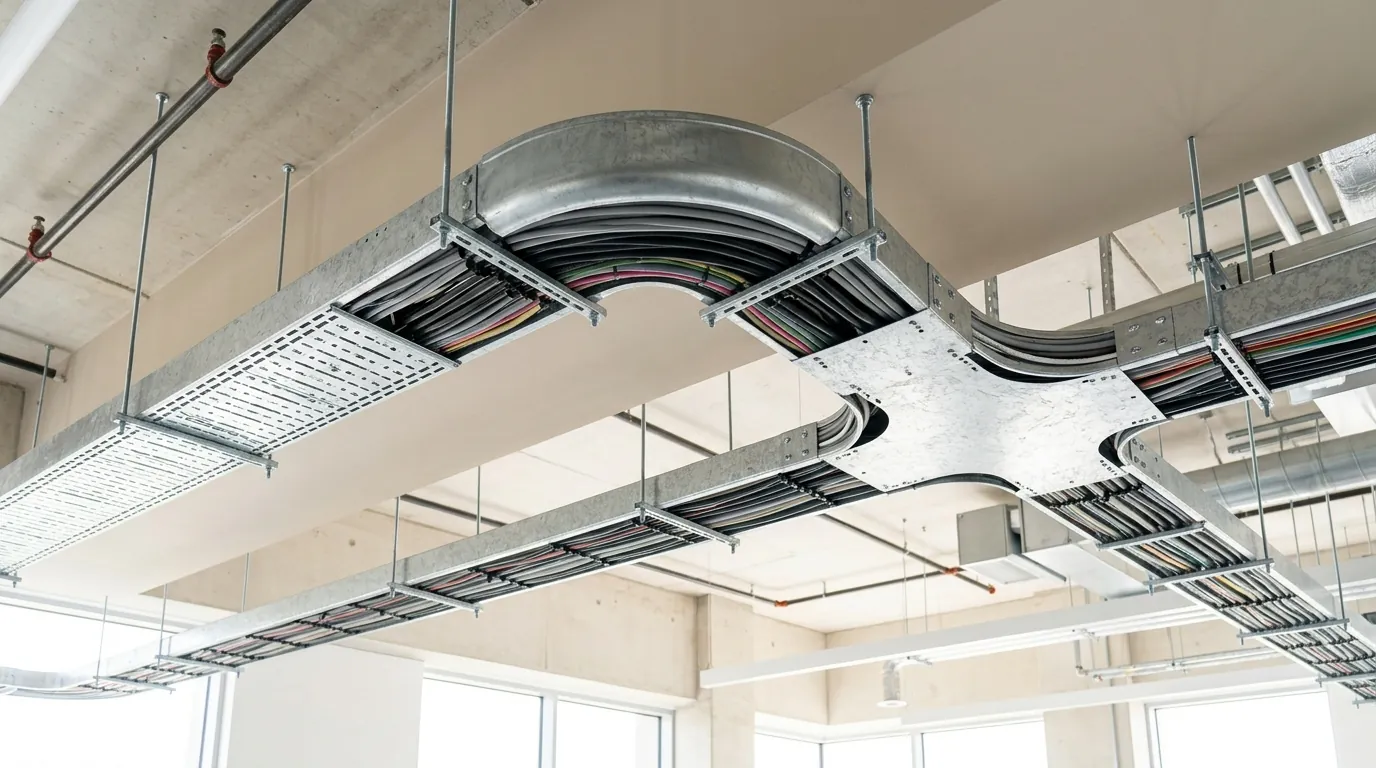
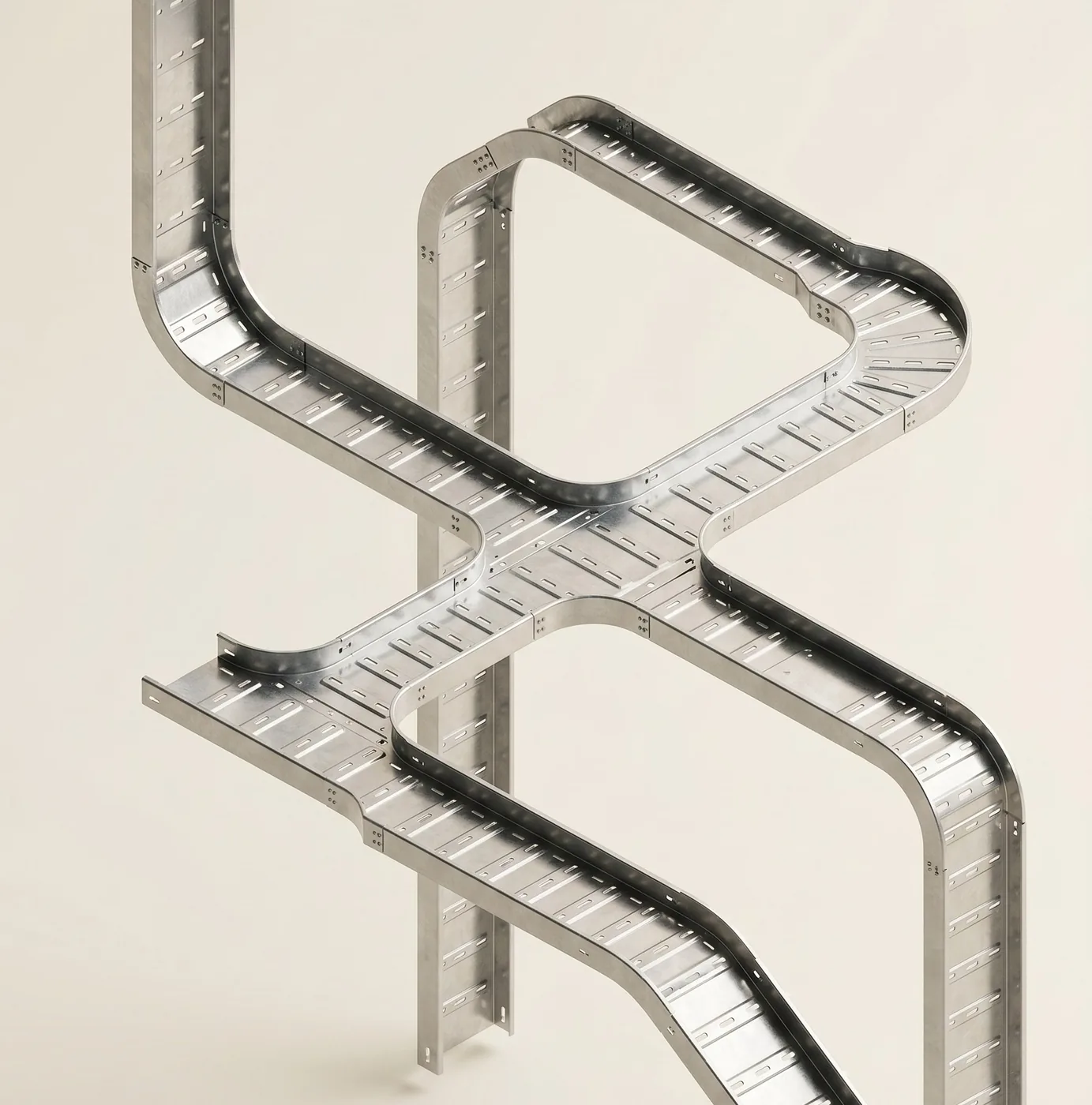
Metosu’s TRC (perforated) and TRU (non-perforated) trays ship in 10 widths (100–900 mm), 4 depths (50–150 mm), and 2 standard lengths (2,400 and 3,000 mm), all in 1.0–3.0 mm steel. Load rating: 420 kg/span, NEMA Class 8B at 2,400 mm span. If the cable weight exceeds that, step up to cable ladder — widths 75–1,200 mm, 1,340 kg/span, Class 8C.
Get the fill ratio wrong and you either derate the cables (too full) or waste steel and bracket cost (too empty). Below — how to land on the right size the first time.
Step 1 — width selection
Width is the dimension you feel the most. A tray that’s too narrow forces you to add a parallel run or re-draw the supports mid-install. Too wide and you’re paying for empty steel.
The basic calculation:
- List every cable that will sit in the tray. Pull the outer diameter from the manufacturer’s data sheet — not the conductor size, the full sheathed OD.
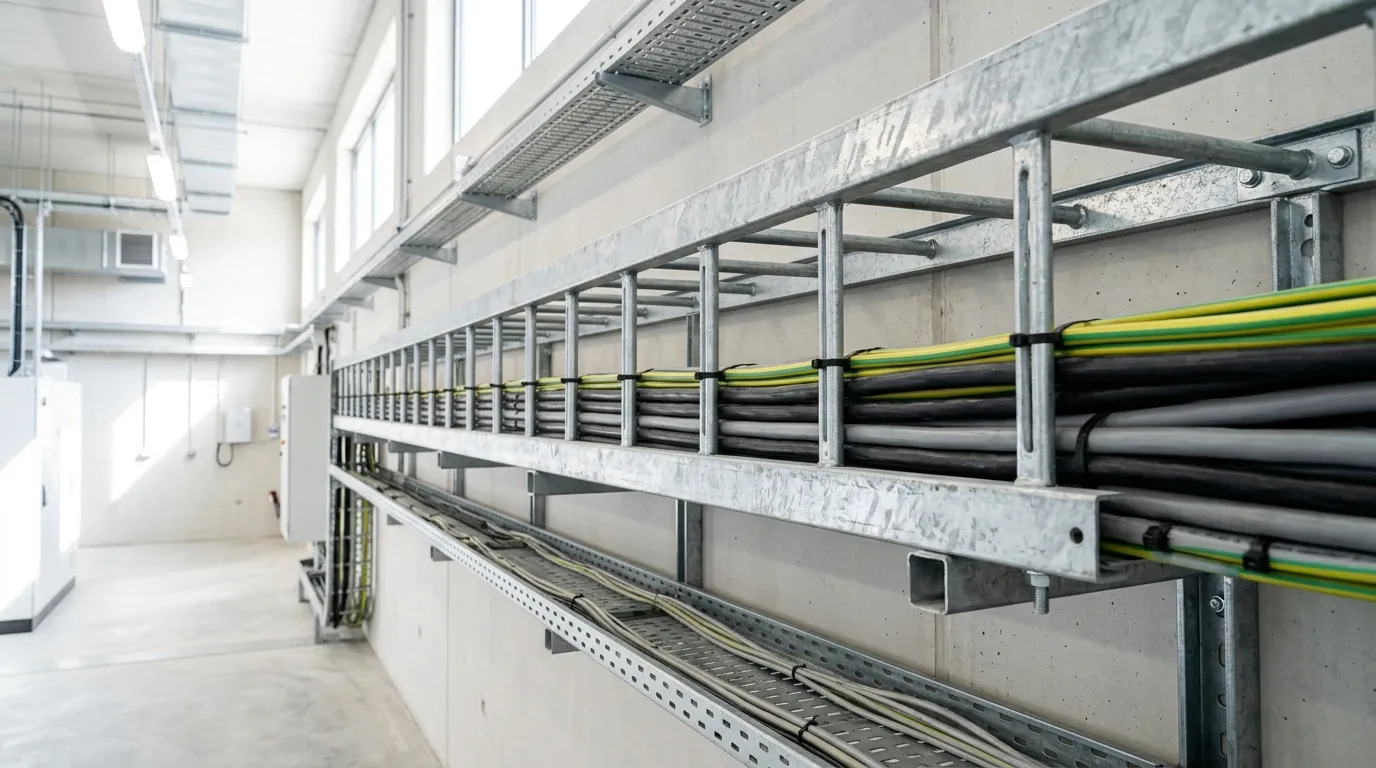
- For single-layer installation (the preferred arrangement), lay the cables side by side with a one-diameter gap between power cables for heat dissipation. Data cables can be touching.
- Sum the diameters plus gaps. That total is your minimum usable width.
- Add 15–20 % for future additions. Every facility grows.
Example: eight power cables at 28 mm OD each, single layer, one-diameter spacing:
- 8 cables × 28 mm = 224 mm of cable
- 7 gaps × 28 mm = 196 mm of spacing
- Subtotal = 420 mm → add 20 % = 504 mm
- Nearest Metosu width: 500 mm (tight) or 600 mm (comfortable)
Metosu standard widths (mm): 100, 150, 200, 250, 300, 400, 500, 600, 750, 900.
For runs that combine power and data cables, treat them as separate zones within the tray — power on one side, data on the other, with a bolted barrier strip or a natural air gap of at least 50 mm between the groups.
Step 2 — depth selection
Depth controls how many cable layers you can stack and how well the bottom layer stays retained during installation and maintenance.
Metosu standard depths (mm): 50, 75, 100, 150.
Rules of thumb:
- 50 mm — single layer of small-diameter cables (Cat 6A, control wire, fibre). Adequate for structured cabling runs where the cable OD is under 10 mm.
- 75 mm — single layer of medium power cables (up to ~25 mm OD) or a double layer of data cables. The most commonly specified depth for mixed commercial runs.
- 100 mm — single layer of larger power cables or two layers of medium cable. Standard choice for industrial LV distribution.
- 150 mm — multi-layer stacking for dense runs. Be careful here: every additional layer adds weight and makes bottom-layer access harder. If you need 150 mm depth, check whether splitting into two parallel trays gives a better result.
Why single-layer matters for power cables: stacking power cables reduces their ampacity. IEC 60364-5-52 applies grouping derating factors — two layers can drop the current rating by 15–20 %, three layers by 25 % or more. Single-layer installation avoids the derating conversation entirely.
For data cables (Cat 6A, fibre) the thermal penalty is negligible, so stacking to two or three layers is normal practice. Just stay within the fill ratio limit.
Step 3 — fill ratio
Fill ratio is the percentage of the tray’s internal cross-sectional area actually occupied by cables. It is the single most important number for long-term performance, and the most frequently ignored during initial design.
The standards say:
| Standard | Power cables | Data / control cables |
|---|---|---|
| Good-practice design margin | 40–50 % max | 50–60 % max |
| NEC Article 392 | 40 % (single conductor), 50 % (multi-conductor) | up to 50–60 % |
IEC 61537 is the product standard for the tray itself and does not set a fill limit. On IEC-based projects, cable heat is managed through the grouping derating factors in IEC 60364-5-52, not a percentage fill cap.
Why not 100 %? Three reasons:
- Heat dissipation. Power cables generate I²R losses. A tray packed to 80 % traps heat, raises conductor temperature, and forces ampacity derating — or worse, accelerates insulation ageing.
- Future additions. Buildings change. The 30 % of empty cross-section you leave today is the capacity that absorbs the next tenant fit-out or equipment upgrade without re-running containment.
- Installation and maintenance access. Cables that are packed tight are cables that are hard to pull, hard to identify, and hard to replace. Contractors price the difficulty into their labour rates.
How to calculate it:
- Usable cross-section of the tray = internal width × depth. For a 300 mm × 100 mm tray: 30,000 mm².
- Sum of cable cross-sections = π/4 × OD² for each cable.
- Fill ratio = (sum of cable areas) / (tray area) × 100 %.
Target 40 % for power, 50 % for data. If the calculation lands above 50 % for any cable type, widen the tray by one standard size or split into two runs.
When to upsize to cable ladder
Cable tray tops out at 420 kg/span (Class 8B) on a 2,400 mm support span, with a deflection limit of L/250 = 9.6 mm. When the cumulative cable weight approaches that limit — or when any of the following conditions apply — switch to cable ladder:
- Cable fill weight exceeds ~50 kg per linear metre. At that density, tray is working near its rated capacity and ladder’s 1,340 kg/span (Class 8C) gives a much more comfortable safety margin.
- Span between supports needs to exceed 2,400 mm. Ladder’s structural profile handles longer spans with less deflection.
- Large-diameter armoured feeders. Cables over 50 mm OD are easier to route on rungs than in a channel — they sit in the gaps and self-locate.
- Outdoor / heavy-industrial environments. Ladder’s open geometry handles wind load better and doesn’t collect water.
Metosu cable ladder ships in widths from 75 to 1,200 mm, in 2,400 / 3,000 / 6,000 mm lengths, with the same two finishes as tray.
Finish selection
Both TRC and TRU trays are available in:
- Hot-dip galvanised (HDG) — to ISO 1461 as standard, with a heavier coat for marine and coastal environments. The default for industrial, outdoor, and heavy-service runs.
- Jotun powder coat — 60–80 µm, any RAL colour, applied over galvanised substrate. The default for visible architectural installations, hospitality, and clean environments.
For outdoor or corrosive-atmosphere applications, always specify the heavier HDG option to ISO 1461 and confirm that all fittings (couplers, elbows, tees, reducers) are finished to the same standard.
Quick-reference sizing table
| Run type | Typical width | Depth | Target fill | Metosu product |
|---|---|---|---|---|
| Structured cabling (Cat 6A, fibre) | 200–300 mm | 50–75 mm | 50 % | TRC perforated |
| Mixed LV power + data (commercial) | 300–500 mm | 75–100 mm | 40 % (power zone) | TRC perforated |
| Industrial LV distribution | 500–750 mm | 100–150 mm | 40 % | TRU non-perforated |
| Heavy power feeders (>50 kg/m) | 300–600 mm | — | 40 % | Cable ladder (SLW/SLU) |
Further reading
Standards:
- IEC 61537:2023 — cable tray and cable ladder systems for cable management
- IEC 60364-5-52 — cable grouping derating factors referenced in the depth section
- NEMA VE 1-2017 — metal cable tray systems
- NEC Article 392 — cable trays (NFPA 70)
Metosu products and catalogues:
- Cable tray — Metosu TRC and TRU product page with full dimensional tables
- Cable ladder — Metosu SLW and SLU product page
- Catalogue download (EN) · (ID)
Questions on sizing for a specific project? Send a cable schedule and single-line diagram to marketing@metosu.com — our engineering team will return a recommended tray spec within one business day.